This post contains Amazon affiliate links.
Solar Generator for Refrigerator and Freezer: What Size Do You Need?
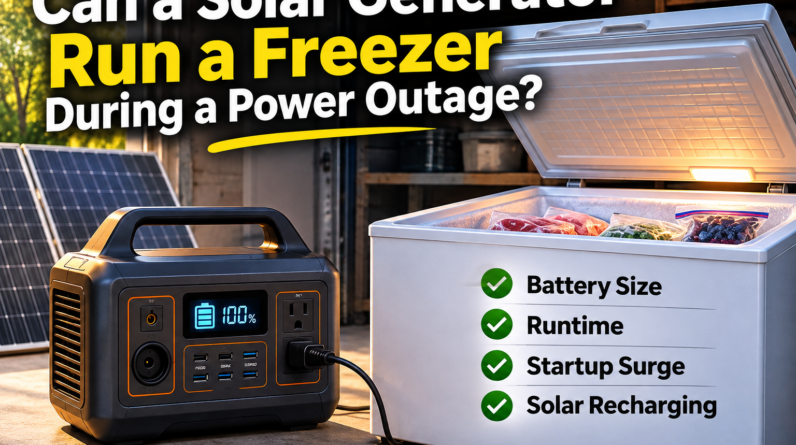
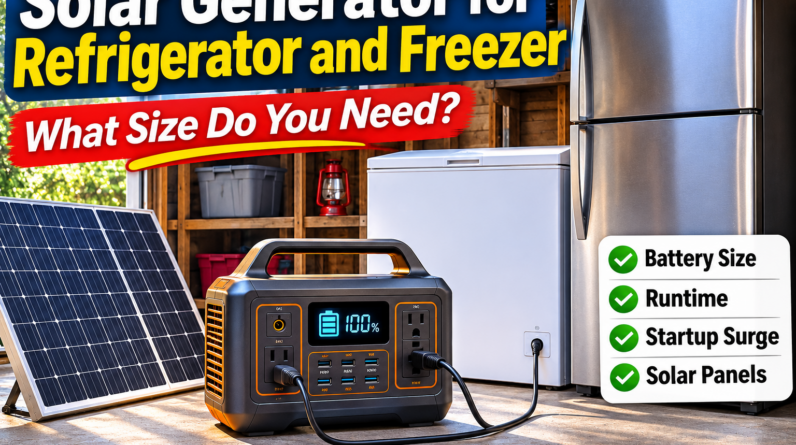
A solar generator for refrigerator and freezer backup can help protect hundreds of dollars in food when the power goes out. The key is choosing enough battery capacity to run both appliances and enough inverter output to handle the compressor startup surge.
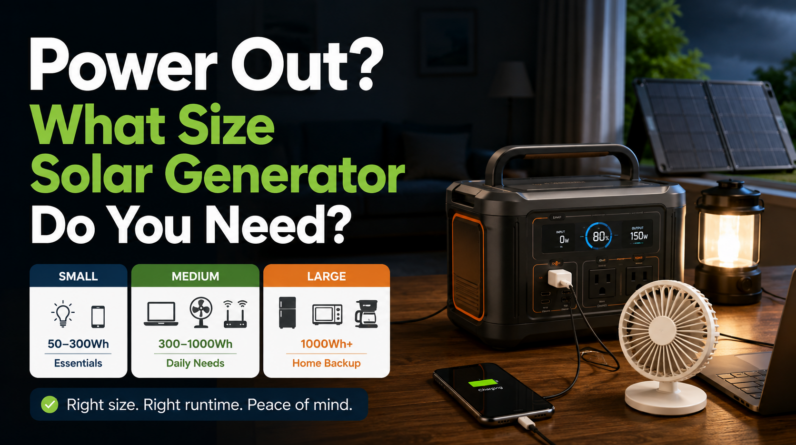
For many households, a 2,000Wh solar generator is a good starting point for refrigerator and freezer backup. Smaller systems may work for short outages, while 3,000Wh or larger batteries provide more flexibility during multi-day outages.
Adding solar panels can extend runtime even further by replacing some of the electricity your refrigerator and freezer use each day.
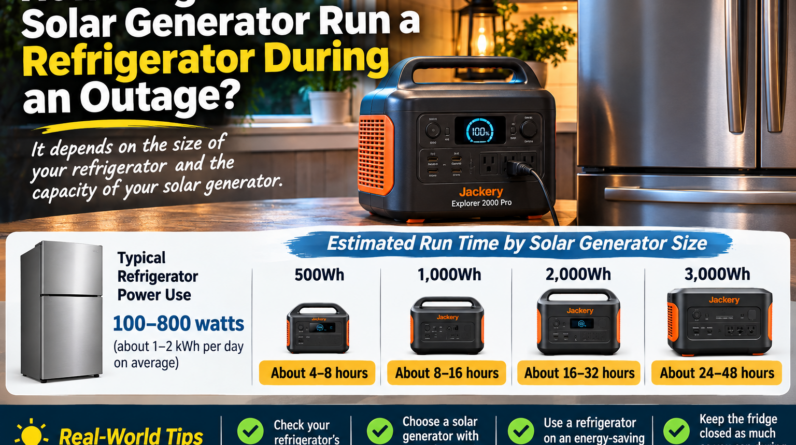
If you are still deciding how much battery capacity you need, read our guide to how long a solar generator will run a refrigerator.
Quick Solar Generator for Refrigerator and Freezer Comparison
| Battery Size | Refrigerator + Freezer Backup |
|---|---|
| 500Wh | Usually too small for meaningful combined backup |
| 1,000Wh | Short-term use for efficient appliances |
| 2,000Wh | Good starting point for many homes |
| 3,000Wh | Better for longer outages |
| 4,000Wh+ | Stronger multi-day reserve |
| Large battery + solar | Best for extended outages |
These are general ranges.
Your actual runtime depends on how much electricity your refrigerator and freezer consume.
How Much Power Does a Refrigerator and Freezer Use?
The first step in choosing a solar generator for refrigerator and freezer backup is estimating the combined energy use of both appliances.
For example, suppose:
- Refrigerator uses 750Wh per day
- Freezer uses 500Wh per day
Combined energy consumption would be:
750Wh + 500Wh = 1,250Wh per day
That means you would need roughly 1,250Wh of usable battery capacity just to cover one day before accounting for inverter losses or other devices.
A 1,500Wh battery would therefore be tight.
A 2,000Wh battery gives you more breathing room.
Why Running Watts Are Not Enough
You may look at the label on your refrigerator and see that it draws 150 watts.
Your freezer might draw 120 watts.
That does not mean they consume:
270 watts × 24 hours
because the compressors cycle on and off.
The appliances only draw their full running power while the compressor is active.
This is why daily watt-hour consumption is more useful than running wattage when sizing a battery.
What Is Startup Surge?
Refrigerators and freezers contain compressors.
When a compressor starts, it may briefly require much more power than it uses while running normally.
This is called startup surge.
Your solar generator must have enough inverter capacity to handle it.
Check both:
- Continuous AC output
- Surge output
A large battery alone is not enough.
You could own a 3,000Wh power station and still have trouble starting an appliance if the inverter cannot handle the surge.
What Size Solar Generator for Refrigerator and Freezer Backup Is Best?
For many households, these ranges make sense.
1,000Wh Solar Generator
A 1,000Wh unit may work for a short outage if both appliances are efficient.
It probably will not provide a full day of combined refrigeration in many homes.
This size is better if you are willing to alternate appliances or use the battery only during part of the outage.
2,000Wh Solar Generator
A 2,000Wh unit is a much stronger starting point.
If your refrigerator and freezer together use around 1,200Wh per day, a battery this size may provide roughly a day of useful backup after losses.
You may also have some capacity left for:
- Phones
- Lights
- Router
- Radio
3,000Wh Solar Generator
A 3,000Wh system gives you more reserve.
This size can be useful for:
- Refrigerator
- Freezer
- Phones
- Wi-Fi
- Lights
- Fans
- Laptop
You also have more protection if the appliances consume more electricity than expected.
4,000Wh or Larger
A larger battery makes more sense for extended outages.
It also gives you a cushion for cloudy weather if you are relying on solar recharging.
Solar Generator for Refrigerator and Freezer Runtime Example
Suppose your appliances use:
Refrigerator:
700Wh per day
Freezer:
500Wh per day
Combined:
1,200Wh per day
Now suppose your solar generator has roughly 1,800Wh of usable battery capacity after losses.
Estimated runtime:
1,800 ÷ 1,200 = 1.5 days
That assumes no solar recharging and no other devices.
Add phones, lights, fans, or a router and runtime decreases.
How Long Will a 1,000Wh Battery Run a Refrigerator and Freezer?
If the two appliances use 1,200Wh per day, a 1,000Wh battery will not last a full day.
Actual runtime could be significantly shorter after inverter losses.
For very efficient appliances, you may get more time.
The easiest way to know is to measure your actual energy use.
How Long Will a 2,000Wh Battery Run Them?
Suppose the battery provides around 1,700Wh of usable AC energy.
If your appliances use 1,200Wh per day:
1,700 ÷ 1,200 = about 1.4 days
That gives you roughly a day or a little more in this example.
Solar charging can extend that substantially.
How Long Will a 3,000Wh Battery Run Them?
Suppose usable capacity is around 2,600Wh.
Using the same 1,200Wh daily load:
2,600 ÷ 1,200 = about 2.2 days
Again, actual results vary.
Use a Power Meter Before Buying
One of the best ways to size a solar generator for refrigerator and freezer use is to measure both appliances.
A plug-in electricity meter can show how many watt-hours each appliance consumes over 24 hours.
Measure for several days if possible.
That gives you a much better number than guessing.
Can One Solar Generator Run Both at the Same Time?
Yes.
A properly sized power station can run a refrigerator and freezer simultaneously.
You need enough:
- Battery capacity
- Continuous inverter output
- Surge output
- AC outlets
The biggest concern is what happens if both compressors start at nearly the same time.
Your inverter needs enough surge capacity to handle that possibility.
Is a Chest Freezer Easier to Back Up?
Often, yes.
Chest freezers can hold cold air well because cold air tends to stay inside when the lid is opened.
Many models are also fairly efficient.
That can make a chest freezer a good candidate for solar backup.
Actual consumption still varies by model.
Does an Upright Freezer Use More Power?
Not always, but upright freezers can lose more cold air when you open the door.
They may also have different defrost systems and energy usage.
Do not assume one type always uses more electricity.
Measure your specific appliance.
Can a 100W Solar Panel Recharge the Battery?
A 100W panel can help, but it may not generate enough daily energy to keep up with both appliances.
If the refrigerator and freezer consume 1,200Wh daily, a single 100W panel will usually be too small for sustained backup.
It can still slow battery depletion.
For more detail, see What Can a 100-Watt Solar Panel Power During an Emergency?.
Is a 200W Solar Panel Enough?
A 200W panel is more useful.
Under favorable sunlight, it may generate a meaningful portion of the electricity your refrigerator and freezer consume each day.
But it may still struggle to fully replace a combined refrigeration load.
Read What Can a 200-Watt Solar Panel Power During an Emergency? for more examples.
Is 400W Better for Refrigerator and Freezer Backup?
Yes.
A 400W solar array is much more practical for combined refrigeration.
If conditions are good, it may generate enough electricity to replace a large portion of your daily consumption.
Our 400-Watt Solar Panel guide explains what this size can support.
What About 800W of Solar?
An 800W array gives you much more margin.
This can be useful if you want to support:
- Refrigerator
- Freezer
- Phones
- Lights
- Router
- Laptop
- Fans
The larger array also recharges a large battery faster.
How Much Solar Do You Need?
The goal is to generate at least as much energy as your appliances consume.
Suppose your refrigerator and freezer use:
1,200Wh per day
If your solar array can reliably generate more than 1,200Wh after losses, you have a chance of maintaining the system for extended periods.
If you generate only 600Wh per day, your battery will still gradually run down.
Battery Capacity vs Solar Panel Size
Both matter.
A large battery without enough solar eventually becomes empty.
A large solar array with a tiny battery may not store enough energy for overnight operation.
A good emergency system balances the two.
For example:
2,000Wh battery + 400W solar
can be a useful combination.
A larger setup could be:
3,000Wh battery + 800W solar
for greater daily energy use.
Can You Keep Both Appliances Running for 3 Days?
Yes, but battery capacity alone can become expensive.
Suppose your refrigerator and freezer use 1,200Wh per day.
For three days:
1,200 × 3 = 3,600Wh
Add system losses and you may need well over 4,000Wh of battery capacity if you have no recharging.
Solar panels can reduce the amount of stored energy you need.
Solar Backup for a 3-Day Outage
A practical setup might include:
- 2,000Wh to 3,000Wh battery
- 400W to 800W solar array
- Refrigerator thermometer
- Freezer thermometer
- Backup charging method
During the day, solar panels replace some of the electricity used overnight.
What About a Week-Long Outage?
For a week-long outage, daily solar production becomes much more important than battery size alone.
The goal is to create a cycle:
Daytime: Solar panels charge the battery and help power appliances.
Night: Battery runs refrigerator and freezer.
Next day: Solar replaces the energy used overnight.
If you can repeat that cycle, your system can operate much longer.
What Happens During Cloudy Weather?
Solar production falls.
That is where larger battery capacity helps.
A 3,000Wh battery gives you more reserve than a 1,000Wh battery if you experience two cloudy days.
You may also need to reduce other loads.
Prioritize Refrigeration
During a prolonged outage, avoid wasting your battery on unnecessary devices.
Priority loads might be:
- Refrigerator
- Freezer
- Medical equipment
- Phones
- Lights
- Router
High-power appliances such as microwaves and coffee makers can drain the battery much faster.
Keep Refrigerator and Freezer Doors Closed
This is one of the easiest ways to reduce power use.
Every time you open a door, cold air escapes.
The compressors then have to run longer.
During an outage:
- Plan what you need before opening the door
- Get everything at once
- Close the door quickly
- Avoid checking temperatures constantly
Use appliance thermometers instead.
Freeze Extra Water Before a Storm
If severe weather is approaching, freeze containers or bottles of water.
They add thermal mass.
That can help the freezer stay cold longer during interruptions.
Frozen bottles can also be moved into the refrigerator or a cooler if needed.
Start With Both Appliances Fully Cold
Before a hurricane or major storm:
- Make sure the refrigerator is cold
- Make sure the freezer is fully frozen
- Charge the solar generator
- Charge power banks
- Test your solar panels
Starting prepared reduces the amount of work your backup system needs to do.
Should You Alternate the Refrigerator and Freezer?
If your battery is small, alternating can sometimes extend runtime.
For example, you might run the refrigerator for a period and then switch to the freezer.
But temperature safety matters.
Do not rely on guesswork.
Use thermometers to monitor both appliances.
A larger power station that can run both continuously is simpler.
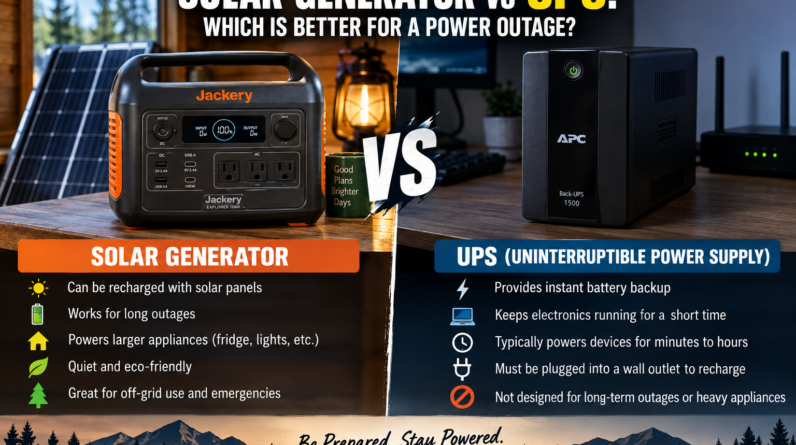
Can a UPS Run a Refrigerator and Freezer?
Most consumer UPS units are not designed for this job.
They typically have smaller batteries and are meant for computers or networking equipment.
A larger portable power station is generally more appropriate.
For a direct comparison, read Solar Generator vs UPS.
Is a Gas Generator Better?
A gas generator can produce more continuous power, but it has drawbacks.
It requires:
- Fuel
- Maintenance
- Outdoor operation
- Safe fuel storage
A battery solar generator can operate indoors and does not produce combustion exhaust.
Some households use both systems for redundancy.
Can You Use a Solar Generator Indoors?
Yes.
Portable battery power stations are designed for indoor use.
Keep the unit:
- Dry
- Ventilated
- Away from excessive heat
- Away from blocked cooling vents
Follow the manufacturer’s operating instructions.
Can You Run Other Devices Too?
Yes, but every additional device shortens refrigeration runtime.
A refrigerator and freezer may already consume most of your daily battery budget.
Small loads such as phones and LED lights are usually manageable.
Larger loads such as:
- Microwave
- Coffee maker
- Space heater
- Air conditioner
can use a lot of stored electricity quickly.
Should You Use a Separate Battery for Other Devices?
That can be a good strategy.
You might dedicate your large solar generator to refrigeration while using smaller power banks for:
- Phones
- Tablets
- Lights
- Radio
This prevents small devices from unnecessarily reducing refrigerator and freezer runtime.
Test Your Setup Before an Outage
Do not wait until the electricity goes out.
Connect both appliances to your solar generator while grid power is still available.
Run the test for several hours.
Better yet, run it for 24 hours.
Check:
- Battery percentage used
- Startup behavior
- Inverter temperature
- Appliance temperatures
- Remaining battery
That gives you a real-world baseline.
How to Choose a Solar Generator for Refrigerator and Freezer Backup
When choosing a solar generator for refrigerator and freezer backup, focus on three numbers: battery capacity, continuous inverter output, and surge output. Battery capacity determines how long your appliances can run, while inverter output determines whether the power station can handle both compressors. For many homes, a 2,000Wh system is a practical starting point, while 3,000Wh or larger batteries provide more reserve for multi-day outages. If you expect prolonged blackouts, choose a model that accepts enough solar input to replace a meaningful amount of your daily refrigeration energy.
Frequently Asked Questions
What size solar generator for refrigerator and freezer backup do I need?
A 2,000Wh system is a useful starting point for many households. A 3,000Wh or larger battery gives you more reserve for longer outages.
Can a 1,000Wh solar generator run a refrigerator and freezer?
Possibly for a limited period, but it may not provide a full day of backup depending on appliance efficiency.
Can a 2,000Wh solar generator run both?
Yes, in many cases. Runtime depends on combined daily energy use.
Can solar panels keep a refrigerator and freezer running?
Yes, if the panels produce enough daily electricity to replace what the appliances consume.
Is 400W of solar enough?
It can provide meaningful refrigerator and freezer support. Whether it fully keeps up depends on appliance energy use and sunlight.
Is 800W better?
Yes. An 800W array provides faster charging and more daily energy, which can be valuable during long outages.
Can a solar generator run a refrigerator and freezer for 3 days?
Yes, if you have enough stored battery capacity or enough solar input to recharge during the outage.
Should I use one large solar generator or two smaller ones?
Both approaches can work. One large unit is simpler, while two units give you redundancy and the option to dedicate one battery to each appliance.
Is a Solar Generator for Refrigerator and Freezer Backup Worth It?
A solar generator for refrigerator and freezer backup can protect your food during outages without requiring gasoline or an outdoor generator.
The most useful starting point for many homes is around 2,000Wh of battery capacity.
Move toward 3,000Wh or more if:
- Outages regularly last several days
- Your appliances use more electricity
- You want to power additional devices
- Solar conditions are unpredictable
Adding 400W to 800W of solar can make the system far more capable during a prolonged outage.
Most importantly, measure your actual refrigerator and freezer energy use before buying.
Once you know how many watt-hours they consume each day, choosing the right battery and solar array becomes much easier.
For more planning help, read How Long Will a Solar Generator Run a Refrigerator During an Outage? and What Can a 400-Watt Solar Panel Power During an Emergency?.
This post contains Amazon affiliate links.