This post contains Amazon affiliate links.
Can You Leave a Solar Power Bank in Your Car?
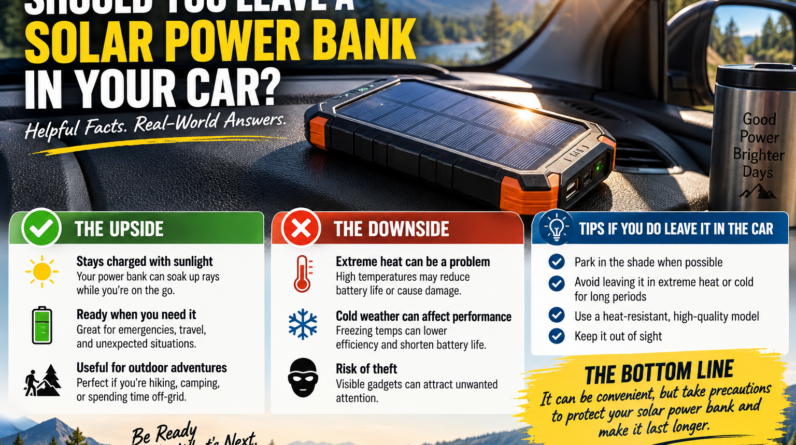
Keeping a solar power bank in your car sounds like a smart emergency-preparedness idea.
Your car is often nearby, the power bank can charge your phone if you are stranded, and the solar panel may provide backup charging when no electrical outlet is available.
There is one major problem: heat.
Most solar power banks contain lithium-ion batteries, and lithium-ion batteries do not handle extreme temperatures well. A parked vehicle can become extremely hot, especially in direct summer sunlight.
So, should you leave a solar power bank in your car?
Not permanently, especially during hot weather. A solar power bank can be useful as part of a vehicle emergency kit, but it is better to protect it from extreme temperatures and periodically bring it inside rather than leaving it in a hot vehicle year-round.
Why Keep a Solar Power Bank in Your Car?
There are plenty of situations where having portable backup power in your vehicle can be useful.
You may need electricity if:
- Your phone battery dies
- Your vehicle breaks down
- You become stranded
- You lose power during a storm
- You need emergency navigation
- You need to contact roadside assistance
- You are camping or traveling
- You need to charge a flashlight or radio
A solar power bank offers another advantage over a standard battery pack.
If you cannot reach an outlet, you may be able to add some electricity using sunlight.
That makes solar charging appealing for emergency kits.
For other compact options, see our guide to small solar chargers that fit in emergency go bags.
The Problem With Leaving a Power Bank in a Hot Car
Most portable power banks use lithium-ion or similar rechargeable battery technology.
High temperatures can reduce battery performance and shorten battery life.
More importantly, severely overheated or damaged lithium batteries can create a safety problem.
The FAA warns that lithium-ion batteries can experience thermal runaway if they are damaged, overheated, overcharged, or exposed to other unsafe conditions.
That does not mean a power bank sitting in your vehicle will automatically catch fire.
It does mean that repeatedly exposing a lithium battery to extreme heat is something you should avoid.
Why Cars Get So Hot
A vehicle sitting in direct sunlight traps heat.
The interior can become far hotter than the outdoor air temperature.
The dashboard, center console, seats, glove compartment, and other surfaces can all become very hot.
Now consider where people commonly leave solar power banks:
- Dashboard
- Windshield
- Center console
- Glove box
- Door compartment
- Trunk
Some of these locations can expose the battery to substantial heat for hours.
Putting the device on the dashboard because you want its solar panel to charge creates an especially bad combination.
The solar panel wants sunlight.
The battery does not want excessive heat.
Should You Put a Solar Power Bank on Your Dashboard?
Usually, no.
The dashboard seems like an obvious place for a solar power bank because sunlight passes through the windshield.
The problem is that the power bank itself can get extremely hot.
A better approach is to use a solar charger that allows the panel and battery to be separated.
For example:
Solar panel in sunlight → charging cable → power bank in shade
This allows the panel to collect sunlight while the battery stays cooler.
Your own emergency solar setup should follow the same principle whenever possible.
Our guide to emergency solar chargers that can charge multiple devices also recommends keeping the battery shaded while the solar panel receives sunlight.
Can a Solar Power Bank Charge Through a Car Windshield?
It may generate some electricity through a windshield, but charging performance can be reduced.
Glass filters and reflects part of the incoming sunlight.
Tinting can reduce it further.
More importantly, putting the entire power bank directly behind a windshield can expose its battery to excessive heat.
So even if you see the solar charging indicator turn on, leaving the device baking on the dashboard is not the best charging strategy.
What About the Trunk?
A trunk may protect the power bank from direct sunlight, which is better than leaving it on the dashboard.
But the trunk can still become very hot.
If you live somewhere with hot summers, leaving a lithium battery in your trunk every day for months is not ideal.
For short-term storage, keeping it protected from direct sunlight and physical damage is better than leaving it exposed.
For long-term emergency preparedness, consider bringing it indoors when extreme temperatures are expected.
What About the Glove Box?
The glove box protects the power bank from direct sunlight.
It does not protect it from the overall temperature inside the vehicle.
That makes it better than the dashboard but still not an ideal year-round storage location in very hot climates.
Can You Leave a Solar Power Bank in the Car During Winter?
Cold creates a different set of problems.
A cold battery may temporarily deliver less power and may charge poorly.
Charging lithium batteries in extreme cold can also be problematic depending on the battery chemistry and design.
The safest approach is to follow the operating and charging temperature limits provided by the manufacturer of your particular power bank.
If your solar power bank has been sitting in a freezing vehicle overnight, allow it to return to an appropriate temperature before charging it if the manufacturer’s instructions require that.
Does Heat Permanently Damage a Power Bank?
Repeated exposure to high temperatures can shorten battery lifespan.
You may eventually notice:
- Reduced capacity
- Faster battery drain
- Longer charging times
- Poorer performance
- Battery swelling
- Unexpected shutdowns
Extreme temperatures can affect lithium battery performance and lifespan, which is one reason batteries in more sophisticated systems use thermal management.
A power bank does not have the elaborate cooling systems found in an electric vehicle.
Protecting it from unnecessary heat is therefore a simple way to help extend its useful life.
How Can You Tell if a Power Bank Is Damaged?
Inspect emergency power banks periodically.
Warning signs can include:
- Swelling
- Bulging
- Cracked housing
- Unusual odors
- Excessive heat
- Leaking
- Strange noises
- Charging problems
- Melted or damaged ports
If a lithium battery is swelling, overheating, smoking, or otherwise obviously damaged, stop using it.
The FAA specifically identifies overheating, expansion, smoking, and burning as warning signs associated with lithium battery problems.
Do not keep using a damaged battery simply because it still charges your phone.
Do Not Puncture a Swollen Battery
A swollen power bank should not be squeezed, punctured, opened, or taken apart.
Damaging the battery can make an unsafe situation worse.
Follow local instructions for disposing of damaged lithium batteries rather than putting one into ordinary household trash.
Can a Solar Power Bank Catch Fire?
Lithium-ion battery fires are uncommon compared with the huge number of batteries used every day, but they can occur.
Risk factors can include:
- Physical damage
- Manufacturing defects
- Excessive heat
- Improper charging
- Short circuits
- Water damage
The FAA notes that lithium-ion batteries are capable of overheating and entering thermal runaway under certain conditions.
For that reason, treat a power bank as a battery first and a solar gadget second.
Where Should You Store a Power Bank in Your Car?
If you need to temporarily keep one in your vehicle, choose a location that is:
- Out of direct sunlight
- Protected from physical damage
- Away from sharp metal objects
- Away from moisture
- Less exposed to heat
- Secure enough that it will not slide around
Do not toss a power bank into a toolbox filled with loose metal tools.
Protect charging ports and keep the battery from being crushed or punctured.
Should You Keep It in a Protective Case?
A protective pouch or case can help protect the power bank from scratches, impacts, and contact with other objects.
Just remember that a case does not solve the heat problem.
Do not wrap a hot battery in heavy insulation while it is charging.
The goal is to protect it from damage without trapping unnecessary heat.
How Often Should You Check a Car Emergency Power Bank?
Checking it every few months is a good habit.
Take it out and inspect it.
Check:
- Battery percentage
- Physical condition
- Charging cables
- USB ports
- Flashlight
- Solar panel
- Case or pouch
Recharge it from a wall outlet if necessary.
Do not assume the battery will still be full simply because you have not used it.
Do Solar Power Banks Lose Charge While Stored?
Yes.
Rechargeable batteries gradually lose some stored energy over time.
The rate varies by device, battery condition, temperature, and electronics inside the power bank.
That means a power bank you charged six months ago may not still be at 100%.
Emergency batteries need occasional maintenance.
Should You Fully Charge It Before Putting It in Your Car?
For an emergency kit, you want enough stored energy to actually be useful.
A nearly empty power bank does not provide much emergency protection.
Charge it before a trip, severe-weather event, hurricane, or other situation where you think you may need it.
Solar charging should generally be treated as an additional charging option rather than your only preparation.
The solar charger review on SolarEmergencyCharger.com discusses a similar approach, with USB charging used as the normal method and solar charging acting as an outdoor or emergency backup.
Solar Charging Is Usually Slower Than USB Charging
One mistake people make is assuming the little solar panel on a power bank will quickly refill the battery.
Usually, it will not.
Built-in solar panels have limited surface area.
They can provide supplemental charging, but a full recharge can take a long time.
If you want serious solar charging capability, a larger folding panel will generally be much more useful.
For outages at home, see Emergency Solar Chargers That Actually Work During Power Outages.
A Foldable Solar Power Bank Can Be Better
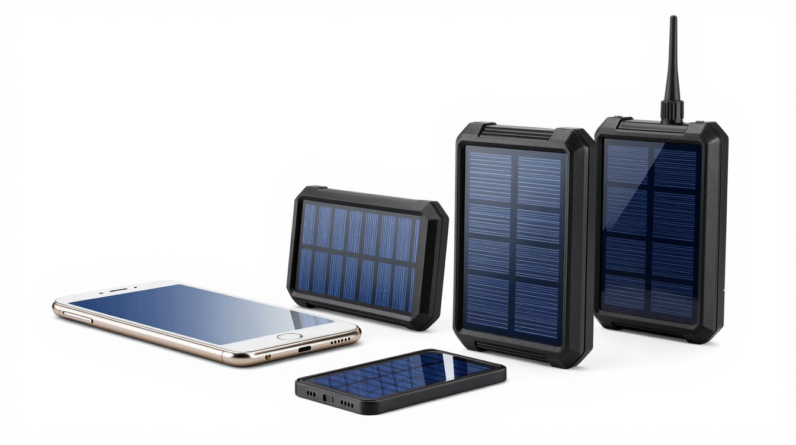
Some power banks include multiple fold-out solar panels.
The additional panel area can collect more sunlight than a single tiny panel built into the front of the battery.
For example, SolarEmergencyCharger.com has reviewed an ADDTOP solar charger power bank with foldable solar panels.
Even with a foldable solar power bank, protect the battery portion from excessive heat whenever possible.
A Separate Solar Panel Is Better for Vehicle Use
For a dedicated vehicle emergency setup, a separate folding solar panel can make a lot of sense.
You can store:
- Folding solar panel
- Power bank
- USB cables
- Car charger
- Emergency radio
- Flashlight
When needed, place only the solar panel in direct sunlight.
Connect it to a battery that remains shaded and ventilated.
This is a better design than putting an entire battery pack on the dashboard.
Keep a USB Car Charger Too
A solar power bank should not be your only way to charge a phone from your vehicle.
Keep a USB car charger in your emergency kit.
If the vehicle is operational, its electrical system may recharge your phone or power bank much faster than a tiny built-in solar panel.
Having both gives you another layer of backup.
What If the Car Battery Is Dead?
That is where having a charged power bank becomes much more valuable.
Your phone can still work even when the vehicle’s electrical system does not.
You may need your phone to:
- Call roadside assistance
- Contact family
- Use emergency services
- Check a map
- Find a nearby service station
- Receive weather information
This is why keeping portable power available in the vehicle is still a good idea.
The goal is simply to store it safely.
Should You Keep More Than One Power Bank?
For a long road trip or family emergency kit, having two smaller power banks can sometimes be better than one large battery.
You gain redundancy.
If one device fails or is accidentally depleted, you still have another.
Multiple power banks also let several people charge separately.
For more ideas on supporting several devices, see Emergency Solar Chargers That Can Charge Multiple Devices.
What Size Power Bank Is Good for a Car Emergency Kit?
A 10,000mAh to 20,000mAh power bank can be a practical size for many people.
It gives you useful phone-charging capacity without becoming excessively large.
A higher-capacity model can provide additional reserve power.
The tradeoff is:
- More weight
- More space
- Longer recharge time
- A larger lithium battery to store
Choose based on how many devices you expect to charge and how long you could be without another power source.
Solar Power Bank vs Regular Power Bank for the Car
A regular power bank can work perfectly well in a vehicle emergency kit.
A solar power bank adds a second charging method.
Regular Power Bank
Advantages:
- Often lighter
- Usually cheaper
- Simple
- Can have large capacity
Disadvantage:
- Once empty, you need an electrical source to recharge it
Solar Power Bank
Advantages:
- Can recharge from USB
- Can collect some solar energy
- Often designed for outdoor use
- May include a flashlight
Disadvantages:
- Solar charging can be slow
- Built-in panels are small
- Putting the battery in sunlight can create heat problems
If you are comparing emergency power options more broadly, read What Are the Pros and Cons of Solar Chargers?.
Solar Power Bank vs Portable Power Station for a Vehicle
A portable power station is much larger than a typical power bank.
It may provide:
- AC outlets
- USB ports
- USB-C charging
- 12V output
- Much larger battery capacity
That makes it useful for longer road trips, camping, and larger emergency loads.
But a large power station also contains a much larger battery.
You should still follow the manufacturer’s temperature and storage instructions rather than permanently leaving an expensive battery system in an extremely hot vehicle.
If you only need phone backup, a smaller power bank is usually easier.
What Should Be in a Vehicle Charging Kit?
A simple emergency charging kit might contain:
- Charged power bank
- USB car charger
- USB-C cable
- Phone-specific charging cable
- Folding solar panel
- Rechargeable flashlight
- Emergency radio
You could also add a small battery jump starter if appropriate for your vehicle.
Keep the kit organized so you can find everything quickly.
A Better Strategy Than Permanently Leaving It in the Car
If you want portable emergency power available while driving, use a simple routine.
During Normal Weeks
Keep the power bank indoors where temperatures are more moderate.
Before a Road Trip
Charge it and put it in your vehicle emergency kit.
Before Severe Weather
Charge it fully and take it with you.
During Extreme Heat
Avoid leaving it permanently in a parked vehicle.
Every Few Months
Inspect and recharge it.
This gives you the emergency benefits without subjecting the battery to unnecessary heat every day of the year.
What About Hurricane Preparedness?
A solar power bank can be particularly useful when you may need to evacuate by vehicle.
Before a hurricane:
- Fully charge your phone.
- Fully charge your power banks.
- Charge rechargeable lights.
- Pack charging cables.
- Keep a USB car charger available.
- Bring portable solar charging if you have it.
Do not count on solar charging immediately after a storm.
Clouds and rain may limit output.
Starting with stored battery power gives you a much better position.
If an outage continues after you return home, our guide on how to keep your phone charged during a 3-day power outage can help you stretch that stored energy.
What About a Winter Emergency Kit?
Portable power is also useful if you become stranded during cold weather.
Keep in mind that extreme cold can temporarily reduce battery performance.
If possible, keep the power bank closer to a moderate temperature instead of leaving it exposed to freezing conditions for long periods.
Again, check the specific temperature limits for your model.
Can You Take a Solar Power Bank on an Airplane?
Usually, power banks must travel in carry-on baggage rather than checked baggage, subject to battery-capacity and airline restrictions.
The FAA currently requires spare lithium-ion batteries and power banks to remain in carry-on baggage, with specific watt-hour limits and additional rules for larger batteries.
Check the latest rules and your airline’s policies before flying.
Frequently Asked Questions
Is it safe to keep a solar power bank in a car?
It can be useful to carry one while traveling, but permanently storing a lithium battery in a vehicle exposed to extreme temperatures is not ideal. Follow the manufacturer’s storage limits and protect the device from direct sunlight and physical damage.
Can I leave a power bank in my car overnight?
Temperature matters more than whether it is day or night. Moderate conditions are less concerning than extreme summer heat or severe cold.
Can I leave a solar power bank on my dashboard?
It is better not to. Direct sunlight can make the power bank extremely hot. If possible, put the solar panel in sunlight while keeping the battery shaded.
Can a solar power bank charge through a windshield?
It may produce some electricity, but glass can reduce solar performance and the device may become very hot behind the windshield.
Can heat ruin a power bank?
Repeated exposure to high temperatures can shorten lithium battery life and reduce performance. Severe overheating can also become a safety concern.
Is a solar power bank useful for roadside emergencies?
Yes. A charged power bank can keep a phone, flashlight, radio, or other small USB device operating if your vehicle loses power.
How often should I recharge an emergency power bank?
Check it every few months and recharge it as needed. Also charge it before road trips or severe-weather events.
Is a regular power bank better for a car?
A standard power bank may be simpler and lighter. A solar model gives you another potential charging source, but the small built-in solar panel should not be your only emergency plan.
Should You Keep a Solar Power Bank in Your Car?
A solar power bank can be an excellent addition to a vehicle emergency kit.
But that does not mean it should live on your dashboard or sit in a scorching trunk throughout the summer.
Treat it like what it really is: a lithium battery that happens to have solar charging capability.
Keep it charged.
Protect it from direct sunlight and physical damage.
Avoid exposing it to extreme temperatures whenever possible.
Inspect it periodically.
And use solar charging as one part of a larger vehicle charging plan that also includes a USB car charger and backup cables.
For a compact emergency kit, check out small solar chargers that fit in emergency go bags.
For home blackout preparation, see Emergency Solar Chargers That Actually Work During Power Outages.
This post contains Amazon affiliate links.