This post contains Amazon affiliate links.
What Can a 400-Watt Solar Panel Power During an Emergency?
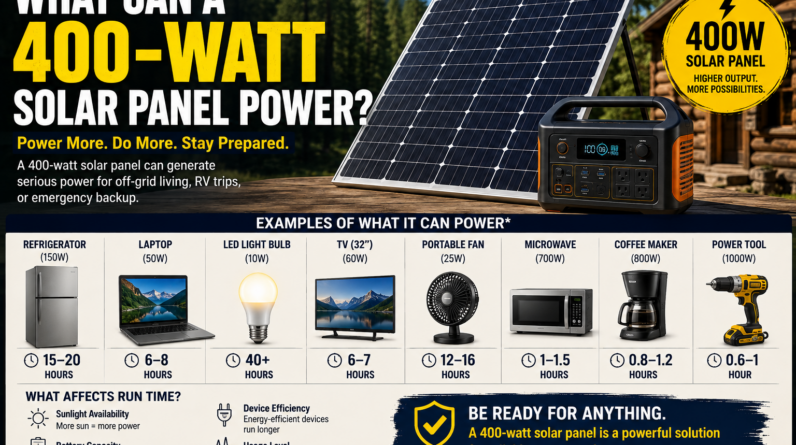
A 400-watt solar panel setup can provide a substantial amount of useful electricity during a power outage.
It still is not the same as whole-house backup, but 400 watts of solar gives you enough charging capacity to support a larger portable power station and a wider range of emergency loads.
With a properly sized battery, a 400W solar setup can help keep refrigerators, freezers, phones, laptops, lights, fans, Wi-Fi equipment, CPAP machines, radios, and other devices operating during an extended outage.
For many households, 400 watts is where portable emergency solar starts to feel much more capable.
How Much Electricity Can a 400-Watt Solar Panel Produce?
A 400-watt solar panel is rated to produce up to 400 watts under favorable conditions.
That does not mean it will generate 400 watts continuously all day.
Actual output depends on:
- Sunlight intensity
- Cloud cover
- Season
- Time of day
- Panel angle
- Shade
- Temperature
- Dirt and debris
- Your location
If you receive the equivalent of five strong peak-sun hours, a simple theoretical calculation would be:
400 watts × 5 hours = 2,000 watt-hours
That equals 2 kilowatt-hours of electricity.
Real-world production is usually lower because solar panels do not remain at their maximum rated output all day and charging systems have efficiency losses.
Even so, 400 watts of solar can produce enough daily energy to make a meaningful difference during a blackout.
What Can You Power With 400 Watts of Solar?
A 400W solar setup can help support many common emergency loads, including:
- Smartphones
- Tablets
- Power banks
- Laptops
- LED lights
- Wi-Fi equipment
- Emergency radios
- Fans
- CPAP machines
- Rechargeable flashlights
- Televisions
- Mini refrigerators
- Full-size refrigerators
- Freezers
- Portable power stations
Larger appliances usually run from the battery or power station rather than directly from the solar panel.
The panel replenishes the energy stored in that battery.
If your needs are smaller, our guide to what a 100-watt solar panel can power during an emergency may be a better fit.
For a middle-ground setup, see what a 200-watt solar panel can power during an emergency.
Why 400 Watts Is a Big Step Up
Moving from 100W or 200W to 400W gives you much more daily charging potential.
That can help when you are trying to support:
- Refrigeration
- Several family members
- Larger power stations
- More daily device usage
- Multi-day outages
- Medical equipment
- Work-from-home equipment
A smaller panel may keep your phone charged.
A 400W system starts to become much more useful for maintaining several important household devices.
You Still Need a Battery
A solar panel does not store electricity.
It only generates power while sunlight is available.
For emergency use, a 400W solar panel is usually paired with:
- Portable power station
- Solar generator
- Expansion battery system
- Compatible battery bank
The battery stores electricity during the day.
You can then use it at night or whenever solar production drops.
If you are still deciding whether a portable battery is worth buying, read Is a Solar Generator Necessary for Short Outages?.
Can a 400W Solar Panel Charge a Phone?
Yes.
Phone charging is an extremely small load for a 400W solar setup.
A single smartphone uses only a fraction of the energy a 400W panel can potentially collect during a sunny day.
You could charge multiple phones, power banks, tablets, and other USB devices while still having plenty of solar capacity left for larger equipment.
For a practical phone-backup plan, see How to Keep Your Phone Charged During a 3-Day Power Outage.
Can a 400W Solar Panel Charge Several Devices at Once?
Yes, assuming your power station has enough ports and output capacity.
A 400W solar setup could easily support charging several small electronics during the day.
For example:
- Two smartphones
- Laptop
- Power bank
- Emergency radio
- Rechargeable flashlight
These devices combined may use far less energy than a refrigerator or space heater.
If your household has several people, our article on emergency solar chargers that can charge multiple devices is also worth reading.
Can a 400W Solar Panel Run a Laptop?
Yes.
A laptop is a relatively modest load for a 400W system.
Suppose your laptop averages 60 watts during use.
Five hours would consume:
60 × 5 = 300Wh
That is only a portion of what a 400W solar array could potentially generate during a sunny day.
This makes a 400W setup useful for people who need to work during an outage.
Can a 400W Solar Panel Run Wi-Fi?
Yes, in most cases.
A modem and router might use roughly 10 to 30 watts combined.
If the equipment uses 20 watts for 12 hours:
20 × 12 = 240Wh
That is a relatively small load compared with the potential daily output of a 400W panel.
Internet service itself may still fail during a widespread outage, but keeping your local equipment powered gives you access whenever the provider’s network remains operational.
Can a 400W Solar Panel Run LED Lights?
Yes.
LED lights are one of the easiest household loads to support with solar power.
Suppose four LED bulbs use 10 watts each.
Together they draw:
40 watts
If you run them for five hours:
40 × 5 = 200Wh
That is a small portion of your possible daily solar production.
Lighting is a very efficient use of emergency electricity.
Can a 400W Solar Panel Run a Fan?
Yes.
Fans are much easier to support than air conditioners.
A 40-watt fan running for eight hours would use:
40 × 8 = 320Wh
A 400W solar setup can generally replace that amount of electricity during a good day while still leaving room for other loads.
During a summer outage, fans can provide a much more realistic cooling option than trying to run air conditioning.
Can a 400W Solar Panel Run a CPAP Machine?
A 400W solar setup can be well suited to CPAP backup.
The actual energy required depends on your machine and whether you use heated humidification or heated tubing.
A battery should provide enough stored energy to run the machine overnight.
The solar panels can then recharge that battery during the day.
For medical equipment, always build extra capacity into the system.
Do not plan around the exact minimum amount of energy you think you need.
Poor weather can reduce solar production.
Can a 400W Solar Panel Run a Refrigerator?
A 400W solar setup is much more practical for refrigerator backup than a 100W or 200W setup.
You still generally do not connect the refrigerator directly to the panels.
Instead, the system works like this:
400W solar panels → portable power station → refrigerator
The battery handles the refrigerator’s compressor startup surge and provides electricity when the sun is not shining.
The solar panels replenish the battery during daylight.
If keeping food cold is a major emergency priority, see Solar Generator for Emergency Food Preservation and Refrigerator Power.
Is 400 Watts of Solar Enough for a Refrigerator?
It can be.
Suppose your refrigerator uses around 800Wh in a day.
If your 400W solar setup generates roughly 1,500Wh that day, you may have enough solar production to replace the refrigerator’s energy use and still have power left for smaller devices.
If the weather is cloudy and you collect only 600Wh, your battery would gradually lose charge.
That is why battery capacity still matters.
Solar production and stored battery energy work together.
Can a 400W Solar Panel Run a Refrigerator and Freezer?
Possibly.
This depends on how efficient both appliances are.
Suppose:
- Refrigerator uses 800Wh per day
- Freezer uses 500Wh per day
Combined:
1,300Wh per day
A 400W solar system might be able to replace that energy under favorable conditions.
However, cloudy weather could create an energy deficit.
If refrigeration is critical, a larger battery gives you a cushion.
Can a 400W Solar Panel Run a Mini Fridge?
Yes, a mini refrigerator can be a good match for a 400W emergency solar setup.
An efficient mini fridge may use relatively little electricity.
That can leave plenty of daily solar capacity for:
- Phones
- Lights
- Router
- Laptop
- Fans
- Radios
A small refrigerator can be a practical option if you only need to protect medications, drinks, or a limited amount of food.
Can a 400W Solar Panel Run a TV?
Yes, depending on the television.
Suppose your television consumes 100 watts.
Watching it for three hours would use:
100 × 3 = 300Wh
A 400W system can support that more easily than a smaller panel setup.
Still, during an extended blackout, you may want to prioritize refrigeration, communication, lighting, and medical needs before entertainment.
Can a 400W Solar Panel Run a Microwave?
Not directly.
A microwave may draw 1,000 watts or more.
A 400W solar panel cannot supply that amount of power directly.
However, a sufficiently powerful battery station can run the microwave briefly.
For example, if a microwave draws 1,200 watts for 10 minutes, it uses roughly:
200Wh
Your solar array can then replace that energy over time.
Short bursts of high-power appliance use can be practical with a large enough battery.
Can a 400W Solar Panel Run a Coffee Maker?
A coffee maker can require 800 to 1,500 watts while heating water.
A 400W panel cannot run it directly.
But a power station with a high enough inverter rating can.
Because coffee makers usually run for only a few minutes, they may use less total energy than you expect.
The important number is both the appliance’s wattage and how long it runs.
Can a 400W Solar Panel Run an Electric Kettle?
A large enough power station can run an electric kettle, but the panel alone cannot.
Many kettles draw around 1,200 to 1,500 watts.
Heating water electrically uses a meaningful amount of stored energy.
During a long outage, you may want to limit how often you use high-power heating appliances.
Can a 400W Solar Panel Run a Space Heater?
A space heater is still a poor match for a 400W emergency solar setup.
Many electric space heaters use around 1,500 watts continuously.
Running one for a single hour may consume:
1,500Wh
That could equal a large portion of an entire day’s solar production.
Electric resistance heating drains batteries very quickly.
Can a 400W Solar Panel Run an Air Conditioner?
A 400W solar setup may help support a very small air conditioner when paired with a large battery, but air conditioning is still a difficult load.
A small window unit might consume 500 to 800 watts or more while running.
That means it can use electricity faster than a 400W solar array can replace it.
A large battery can handle the difference temporarily, but eventually the battery will run down if solar production cannot keep up.
Fans remain a much easier cooling option.
How Long Will 400W of Solar Take to Charge a 500Wh Power Station?
The theoretical calculation is:
500Wh ÷ 400W = 1.25 hours
Actual charging will take longer.
The panel may not continuously produce 400 watts, and charging losses reduce efficiency.
The power station must also support a 400W solar input.
If its maximum input is only 200W, the battery will charge at a slower rate.
How Long Will 400W Take to Charge a 1,000Wh Power Station?
The theoretical calculation is:
1,000Wh ÷ 400W = 2.5 hours
Real charging may take several hours under strong sunlight.
A 1,000Wh battery paired with 400W of solar can be a strong emergency combination because the solar array can replenish a large percentage of the battery during one good day.
How Long Will 400W Take to Charge a 2,000Wh Power Station?
The theoretical calculation is:
2,000Wh ÷ 400W = 5 hours
Actual charging takes longer.
A 2,000Wh battery paired with 400W solar can be a very capable emergency setup.
It provides enough stored energy for larger appliances while still offering meaningful daytime recharging.
400W Solar With a 500Wh Power Station
This pairing gives you a relatively small battery with a large solar input.
Under strong conditions, the battery may recharge quickly.
That can be useful if you want to use the battery repeatedly throughout the day.
However, the power station must actually accept 400 watts of solar input.
400W Solar With a 1,000Wh Power Station
This is a strong combination for emergency use.
It can support:
- Phones
- Lights
- Laptops
- Wi-Fi
- Fans
- CPAP
- Refrigerator
- Radio
A 400W array can replenish a large portion of the battery during good daylight conditions.
400W Solar With a 2,000Wh Power Station
This setup offers more stored energy for longer outages.
It can support refrigeration plus several smaller household loads.
A 2,000Wh battery also gives you more protection against cloudy weather.
Even if solar production is poor for a day, you still have stored electricity available.
400W Solar With a 3,000Wh or Larger Power Station
A 400W solar array can still work with a large battery, but charging will be slower.
If you regularly use several thousand watt-hours per day, you may eventually want 600W, 800W, or more solar capacity.
Larger batteries are most useful when you also have enough solar input to replenish them.
How Much Can a 400W Solar Panel Produce in One Day?
A rough theoretical estimate using five peak-sun hours is:
400W × 5 = 2,000Wh
Actual production may be lower.
Suppose you collect 1,500Wh in a day.
That amount of electricity could potentially cover a combination such as:
- Refrigerator
- Several phone charges
- LED lighting
- Wi-Fi
- Laptop use
- Fan
- Radio
How far that energy goes depends on the efficiency of your devices.
What Should You Power First?
During a blackout, prioritize your electricity.
Medical Equipment
Necessary medical devices should come first.
Refrigeration
Protect food, medications, and other temperature-sensitive items.
Communication
Keep phones and radios charged.
Lighting
Use efficient LED lights.
Internet
Power your router if internet service remains available.
Fans
Use efficient fans for cooling.
Work Equipment
Laptops and other work devices can come next.
Entertainment
Televisions and gaming equipment should usually be lower priority during a long outage.
What Happens on a Cloudy Day?
A 400W solar panel still produces electricity under cloud cover, but output can drop substantially.
You may collect only a fraction of the energy you would receive on a clear day.
This is one reason a larger battery is useful.
You can store extra energy during sunny periods and use it when solar conditions are poor.
For more on the limitations of solar charging, see What Are the Pros and Cons of Solar Chargers?.
Does Shade Affect a 400W Solar Panel?
Yes.
Shade can reduce output significantly.
Watch for shadows from:
- Trees
- Buildings
- Vehicles
- Chimneys
- Fences
- Utility poles
Check the panel position throughout the day.
A location that looks perfect in the morning may be shaded by afternoon.
Should You Reposition the Panels?
Yes, if practical.
Portable solar panels often include kickstands.
Adjusting the angle toward the sun can improve output.
You do not need to constantly move them.
A few adjustments during the day can be enough.
One 400W Panel or Two 200W Panels?
Either setup can work.
A single 400W panel may be simpler to connect.
Two 200W panels can give you more placement flexibility.
You might also find two smaller folding panels easier to carry and store.
Before connecting multiple panels, check your power station’s:
- Maximum voltage
- Maximum current
- Maximum wattage
- Connector requirements
Do not exceed the manufacturer’s input limits.
Four 100W Panels vs One 400W Panel
Four 100W panels can give you even more flexibility.
You can spread them out around obstacles or use fewer panels when you do not need the full system.
The disadvantages include more cables and a more complicated setup.
A single 400W folding panel can be quicker to deploy.
The better choice depends on your storage space and power station.
Is 400W Enough for a 3-Day Power Outage?
For many households, it can be enough to support essential devices if the weather cooperates.
A 400W setup may handle:
- Refrigerator
- Phones
- Lights
- Router
- Laptop
- Fans
- Radio
- CPAP
You still need to manage energy carefully.
If you try to run air conditioning, space heaters, cooking appliances, and several large devices, 400W will quickly feel limited.
For phone-specific planning, see How to Keep Your Phone Charged During a 3-Day Power Outage.
Is 400W Enough for a Week-Long Outage?
It can be useful, but the answer depends on your daily energy use and weather.
Solar power becomes more valuable as an outage continues because it gives you a way to replenish your battery.
A large battery without solar eventually becomes empty.
A solar panel gives you the ability to generate new electricity each day.
For a week-long outage, however, cloudy weather and higher energy use can create problems.
A larger solar array gives you more margin.
Who Should Consider 400 Watts of Solar?
A 400W emergency solar setup may be a good fit for:
- Homeowners
- Renters with outdoor panel space
- RV owners
- People in hurricane-prone areas
- People who experience frequent outages
- Families
- Remote workers
- People with medical equipment
- Anyone who wants refrigerator backup
If you only want to keep one phone and a flashlight charged, a smaller setup will probably be easier and cheaper.
Our guide to small solar chargers that fit in emergency go bags covers more portable options.
100W vs 200W vs 400W for Emergency Power
Here is a simple way to think about it.
100W: Good for phones, lights, power banks, radios, and smaller electronics.
200W: Better for laptops, fans, larger batteries, CPAP machines, and limited refrigeration support.
400W: Better for refrigerators, freezers, larger power stations, families, and multi-day outages.
There is no single best size.
The right amount depends on what you want to power.
Frequently Asked Questions
What can a 400-watt solar panel run?
A 400W solar setup can help power or recharge refrigerators, phones, laptops, LED lights, routers, fans, CPAP machines, radios, power banks, portable power stations, and many other emergency devices when paired with a compatible battery.
How much electricity does a 400W solar panel produce per day?
A theoretical five hours at full output would produce 2,000Wh, or 2kWh. Actual daily production will vary depending on sunlight and other conditions.
Can 400 watts of solar run a refrigerator?
A 400W solar setup can often provide meaningful refrigerator backup when paired with a suitable battery. Whether it can fully replace the refrigerator’s daily consumption depends on the appliance and solar conditions.
Can 400 watts of solar run a refrigerator and freezer?
Possibly. Efficient appliances may consume less energy than a 400W array produces on a good day, but cloudy weather can reduce production.
Can a 400W solar panel charge a 1,000Wh battery?
Yes. The theoretical minimum would be about 2.5 hours at a continuous 400W, but real-world charging generally takes longer.
Can a 400W solar panel charge a 2,000Wh battery?
Yes. The theoretical calculation is five hours at a constant 400W, although real-world conditions increase charging time.
Can 400 watts run an air conditioner?
The solar panels themselves generally cannot directly run a typical air conditioner. A large battery could operate a smaller AC unit temporarily, but the appliance may consume energy faster than 400W of solar can replace it.
Is 400 watts enough for emergency power?
For many basic home emergency loads, yes. A 400W setup can support refrigeration, communication, lighting, internet access, laptops, fans, and other important devices when paired with enough battery storage.
Is a 400-Watt Solar Panel Worth It for Emergency Backup?
For households that want more than basic phone charging, 400 watts can be a very useful amount of portable solar capacity.
It gives you enough potential daily energy to support refrigeration and multiple smaller devices while still remaining far more portable than a permanent home solar installation.
Pair 400W of solar with a properly sized battery and you can build an emergency system capable of keeping many important devices running through a multi-day outage.
If you need less power, start with what a 100-watt solar panel can power or what a 200-watt solar panel can power.
If keeping your food cold is your biggest concern, read Solar Generator for Emergency Food Preservation and Refrigerator Power next.
This post contains Amazon affiliate links.