This post contains Amazon affiliate links.
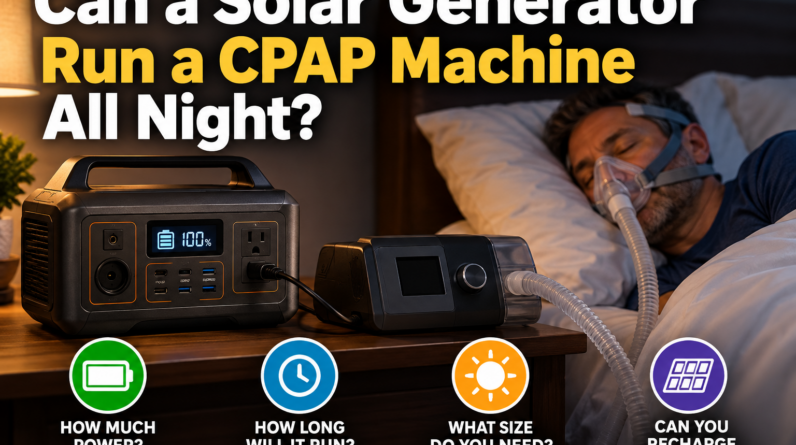
Can a Solar Generator Run a CPAP Machine All Night?
Yes, a solar generator can run many CPAP machines through the night.
The bigger question is how large the battery needs to be.
A CPAP machine may use a relatively small amount of electricity by itself, but heated humidifiers and heated tubing can increase power consumption significantly.
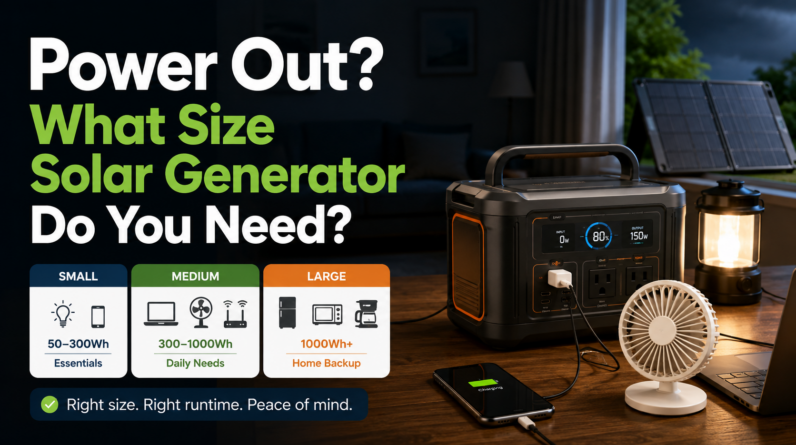
For many users, a portable power station in the 300Wh to 500Wh range may be enough for one night. If you need several nights of backup, use heated features, or want extra reserve power, a 500Wh to 1,000Wh or larger unit can make more sense.
The safest approach is to calculate the actual power use of your specific CPAP machine before choosing a solar generator.
If you are also comparing general emergency battery sizes, see our guide to what size solar generator you need for a power outage.
Quick CPAP Backup Power Comparison
| Backup Setup | Best For | Approximate Battery Size |
|---|---|---|
| Small power station | One night, low-power CPAP use | 300Wh to 500Wh |
| Medium power station | One to several nights | 500Wh to 1,000Wh |
| Larger solar generator | Multi-day outages and extra devices | 1,000Wh+ |
| Solar generator plus solar panel | Extended outages | 500Wh+ with solar input |
These are general ranges.
Your actual needs depend on the CPAP machine, settings, humidifier, tubing, battery losses, and number of hours you sleep.
How Much Electricity Does a CPAP Machine Use?
CPAP machines vary widely.
Some use relatively little electricity when running without heated features.
Others use much more power when you turn on:
- Heated humidifier
- Heated tubing
- Higher pressure settings
- Additional accessories
This means two people using similar CPAP machines may have very different battery requirements.
The best place to start is the power label on your machine or power adapter.
Look for watts, volts, and amps.
How Do You Calculate CPAP Battery Needs?
The basic formula is:
Watts × Hours = Watt-hours
Suppose your CPAP averages 40 watts.
If you sleep for eight hours:
40 × 8 = 320Wh
That means the machine would theoretically consume about 320 watt-hours.
You should add extra capacity for inverter losses and unexpected power use.
A 500Wh power station would therefore be a better choice than trying to use a battery rated at exactly 320Wh.
Example With a Lower-Power CPAP
Suppose your machine averages only 20 watts.
For eight hours:
20 × 8 = 160Wh
That is a much easier load.
A 300Wh battery may be enough for one night, depending on real-world losses.
A 500Wh unit would give you more reserve.
Example With a Heated Humidifier
Now suppose your setup averages 60 watts because you are using a heated humidifier and heated tubing.
For eight hours:
60 × 8 = 480Wh
A 500Wh battery may be too close to the minimum once inverter losses are considered.
In this case, a 700Wh to 1,000Wh power station could provide a more comfortable margin.
Why Heated Humidifiers Matter So Much
Heating requires electricity.
The blower motor in a CPAP may use relatively little power.
Heating water and tubing can increase consumption substantially.
During an extended outage, one of the easiest ways to reduce battery use may be to turn off heated features if your doctor and equipment instructions allow it.
Do not change prescribed therapy settings just to save battery power.
Can a 300Wh Solar Generator Run a CPAP Overnight?
Possibly.
A 300Wh battery may be enough for a lower-power CPAP running without heated features.
It may not be enough for a machine using a heated humidifier throughout the night.
If your CPAP averages 25 watts for eight hours:
25 × 8 = 200Wh
That gives you some room in a 300Wh battery.
If the system averages 50 watts:
50 × 8 = 400Wh
A 300Wh battery would not be enough.
Can a 500Wh Solar Generator Run a CPAP Overnight?
For many CPAP setups, yes.
A 500Wh battery gives you much more flexibility.
It may be enough for one full night with heated features or more than one night with a lower-power setup.
The exact result depends on your equipment.
If your CPAP is medically necessary, avoid planning around the absolute minimum capacity.
Extra reserve is worth having.
Can a 1,000Wh Solar Generator Run a CPAP for Several Nights?
Often, yes.
Suppose your CPAP uses 200Wh per night.
A 1,000Wh battery could theoretically provide about five nights before losses.
Actual runtime would be lower.
If your CPAP uses 400Wh per night, the same battery might provide closer to two nights.
This is why knowing your real power consumption matters more than relying on a generic number.
Can You Run a CPAP and Other Devices at the Same Time?
Yes, if the solar generator has enough battery capacity and output.
You may also want to power:
- Phone
- Wi-Fi router
- LED light
- Fan
- Laptop
- Emergency radio
Those devices all draw from the same battery.
For example, your CPAP may use 250Wh overnight while phones and lighting use another 100Wh.
Now your total is 350Wh.
If you add a fan, your overnight use could climb much higher.
Is a 500Wh Battery Enough for CPAP Plus a Phone?
Usually, it can be.
Phone charging requires relatively little electricity compared with a CPAP.
A phone might use only a few dozen watt-hours for a full recharge.
If you are trying to keep phones operating during a blackout too, see How to Keep Your Phone Charged During a 3-Day Power Outage.
Is a 500Wh Battery Enough for CPAP Plus a Fan?
It depends on the fan.
A small USB fan may use very little electricity.
A larger household fan may consume much more.
Suppose:
- CPAP uses 250Wh
- Fan uses 200Wh overnight
Combined:
450Wh
That would put a 500Wh power station near its limit before accounting for losses.
A larger battery would be safer.
Can You Use a Solar Generator Indoors With a CPAP?
Yes.
Battery-based portable power stations do not produce engine exhaust during normal use.
That makes them much better suited to bedrooms than gasoline generators.
Keep the unit:
- Dry
- Ventilated
- Away from heat sources
- Uncovered
- Protected from physical damage
Follow the manufacturer’s instructions for indoor use.
Is a Gas Generator Safe for a CPAP Indoors?
No.
Never operate a gasoline-powered generator indoors, in a garage, or near an open window.
Gas generators produce carbon monoxide.
A battery power station does not have that problem during normal operation.
Can You Plug a CPAP Directly Into a Solar Generator?
Usually, yes.
Most portable power stations include AC outlets.
You simply plug the CPAP power adapter into the power station.
Some CPAP machines can also use DC power.
Using DC may reduce conversion losses because the battery does not need to convert power from DC to AC and back again.
Check whether your specific CPAP supports a compatible DC cable.
Is DC Power Better Than AC for a CPAP?
It can be more efficient.
A portable power station stores DC electricity.
When you use an AC outlet, the inverter converts that electricity to AC.
Your CPAP power adapter may then convert it back to DC.
Each conversion wastes some energy.
A compatible DC connection may reduce those losses.
However, only use cables approved for your machine and power source.
Do not improvise a connection.
Should You Turn Off the Solar Generator’s Unused Outputs?
If your power station allows it, yes.
Turn off AC, USB, or DC outputs you are not using.
Some power stations consume a small amount of electricity simply keeping their inverter active.
During a multi-day outage, reducing unnecessary standby consumption can help.
How Long Will a Solar Generator Run a CPAP?
A rough calculation is:
Usable battery capacity ÷ average CPAP watts = approximate runtime
Suppose you have a 500Wh battery and your CPAP averages 30 watts.
Ignoring losses:
500 ÷ 30 = about 16.7 hours
Actual runtime will be lower.
If your machine averages 60 watts:
500 ÷ 60 = about 8.3 hours
Again, real runtime would be less.
How Many Nights Can a 500Wh Battery Provide?
Here is a simple example.
If your CPAP uses:
150Wh per night: potentially around three nights before losses
250Wh per night: roughly two nights before losses
400Wh per night: roughly one night
These are only estimates.
How Many Nights Can a 1,000Wh Battery Provide?
If your CPAP uses:
150Wh per night: potentially several nights
250Wh per night: roughly three to four nights before losses
400Wh per night: roughly two nights
A larger battery also gives you room for phones, lights, and other essential devices.
Can Solar Panels Recharge the Battery During the Day?
Yes.
This is what makes a solar generator especially useful for longer outages.
You use stored battery power overnight.
Then you put the solar panel outside during daylight and recharge the battery.
The setup looks like this:
Solar panel → portable power station → CPAP at night
If the weather cooperates, you may be able to repeat this cycle for several days.
Is a 100W Solar Panel Enough for CPAP Backup?
It can be.
Suppose your CPAP uses 200Wh each night.
A 100W solar panel may be able to replace that energy during a good sunny day.
Weather and charging losses matter.
Our guide to what a 100-watt solar panel can power during an emergency gives you a better idea of what to expect.
Is a 200W Solar Panel Better?
Yes, if you have room for it.
A 200W panel can recharge the battery faster.
That gives you more margin during:
- Short winter days
- Partly cloudy weather
- Higher CPAP consumption
- Multiple-device use
See What Can a 200-Watt Solar Panel Power During an Emergency? for more detail.
Would a 400W Solar Panel Be Too Much?
Not if you are supporting more than just the CPAP.
A 400W array may make sense if you also want to run:
- Refrigerator
- Freezer
- Router
- Laptops
- Fans
- Lighting
Our 400-watt emergency solar guide covers larger backup setups.
What Happens on a Cloudy Day?
Your solar panels will usually produce less electricity.
That means your battery may not fully recharge before the next night.
For medically necessary equipment, this is a major reason to have extra battery capacity.
Do not size your system around perfect weather.
Should You Have a Second Backup Battery?
If the CPAP is medically necessary, redundancy can be very useful.
A backup plan might include:
- Primary solar generator
- Second power bank or battery
- Vehicle charging
- Solar panel
- AC charger
- Approved DC cable
The idea is to avoid having only one charging method.
Can You Charge a Solar Generator From a Car?
Many portable power stations support vehicle charging.
That gives you another backup method if sunlight is poor.
Vehicle charging is usually slower than wall charging.
It can still be useful during an extended outage.
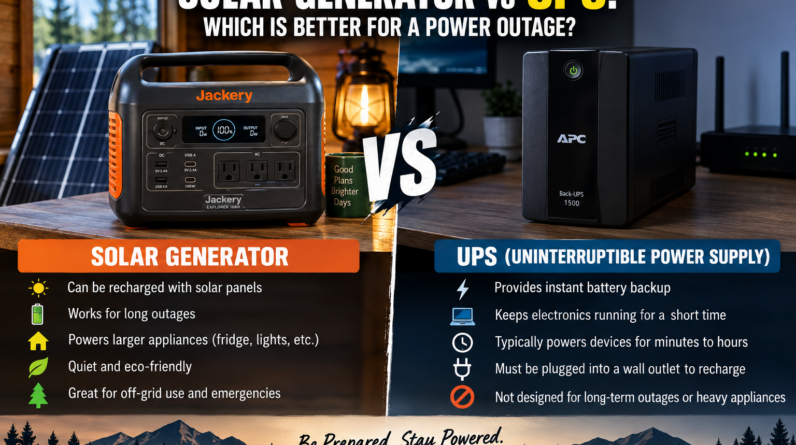
Can You Use a UPS With a CPAP?
Possibly.
A UPS can provide short-term battery backup.
However, many consumer UPS units have less battery capacity than portable power stations.
For an entire night, a solar generator may be more practical.
Our comparison of Solar Generator vs UPS for a Power Outage explains the differences.
CPAP Backup for Apartment Dwellers
A solar generator can be a particularly useful option in an apartment.
You cannot safely run a gasoline generator indoors.
A battery power station can operate inside without combustion exhaust.
You may also be able to recharge it from a portable solar panel on a balcony or patio.
See our guide to the best solar backup power setup for apartment dwellers for a larger apartment emergency plan.
CPAP Backup During a Hurricane
Hurricanes can cause outages lasting several days.
Before the storm:
- Fully charge the power station
- Charge your phone
- Charge backup power banks
- Test the CPAP with the battery
- Pack all cables
- Check solar panel connections
- Keep vehicle charging available
Do not wait until the power fails to test your setup.
CPAP Backup During a Winter Storm
Winter outages create a different problem.
Solar days are shorter and cloudy weather may reduce charging.
Cold can also affect batteries.
A larger battery gives you more reserve energy when solar production is poor.
Test Your Setup Before You Need It
This is one of the most useful things you can do.
Run your CPAP from the solar generator for one normal night while grid electricity is still available.
In the morning, check how much battery remains.
This gives you a real-world measurement based on:
- Your CPAP
- Your settings
- Your humidifier
- Your tubing
- Your sleep duration
- Your battery system
That information is much more useful than a generic estimate.
Do a Second Test Without Heated Features
If your equipment and medical needs allow it, you may also want to see how much less electricity the system uses without heated humidification or heated tubing.
That tells you how much emergency runtime you could gain if conserving power becomes necessary.
Do not change prescribed therapy settings without appropriate medical guidance.
Keep the Battery Charged
A power station sitting at 25% is not much of an emergency backup.
Before severe weather:
- Charge it fully
- Confirm it powers the CPAP
- Check cables
- Test solar input
- Test vehicle charging
- Inspect the battery
You want to discover problems before the outage begins.
Should You Buy a Dedicated CPAP Battery Instead?
A dedicated CPAP battery may be smaller and easier to travel with.
A solar generator gives you more flexibility.
You can also use it for:
- Phone
- Lights
- Router
- Laptop
- Fan
- Radio
If your only backup need is the CPAP, a dedicated battery may be worth comparing.
If you need broader household emergency power, a portable power station is usually more versatile.
Frequently Asked Questions
Can a solar generator run a CPAP for 8 hours?
Yes, if the battery has enough usable capacity. A lower-power CPAP may need only a few hundred watt-hours, while heated features can increase consumption.
What size solar generator do I need for a CPAP?
A 300Wh to 500Wh unit may be enough for one night in some setups. A 500Wh to 1,000Wh or larger system gives you more reserve and may support several nights.
Can a 500Wh power station run a CPAP all night?
Often, yes. The answer depends on the CPAP’s power consumption and whether heated features are used.
Can a 1,000Wh solar generator run a CPAP for multiple nights?
In many cases, yes. Actual runtime depends on the machine and settings.
Does a heated humidifier use more battery?
Yes. Heated humidifiers and heated tubing can increase electricity use significantly.
Can I recharge my CPAP battery with solar?
Yes, if your portable power station supports solar input.
Is a 100W solar panel enough to recharge a CPAP battery?
It may be enough for a low-to-moderate daily CPAP load during good sunlight. A 200W panel gives you faster charging and more margin.
Can I use a solar generator indoors?
Yes. Battery-based portable power stations are designed for indoor use and do not produce combustion exhaust.
What Size Solar Generator Is Best for CPAP Backup?
For one night of basic CPAP use, a 300Wh to 500Wh battery may be enough.
For heated humidification, multiple nights, or extra reserve, 500Wh to 1,000Wh is more comfortable.
For multi-day outages where you also need phones, lights, fans, internet, or refrigeration, 1,000Wh or more may make more sense.
Most importantly, test your own CPAP with the battery before you depend on it.
Run it overnight.
Check how much electricity it actually uses.
Then size your backup system with room to spare.
If you are building a larger outage plan around your CPAP, read What Size Solar Generator Do I Need for a Power Outage? and How to Keep Your Phone Charged During a 3-Day Power Outage next.
Suggested Meta Title: Can a Solar Generator Run a CPAP All Night?
Suggested Meta Description: Can a solar generator run a CPAP all night? Learn what battery size you need, how humidifiers affect runtime, and how to recharge with solar.
Suggested URL Slug: solar-generator-run-cpap-all-night
Primary Keyword: solar generator for CPAP
Secondary Keywords: can a solar generator run a CPAP, CPAP battery backup, power station for CPAP, solar generator CPAP overnight, CPAP power outage backup
Internal Links Included:
- What Size Solar Generator Do I Need for a Power Outage?
- How to Keep Your Phone Charged During a 3-Day Power Outage
- What Can a 100-Watt Solar Panel Power During an Emergency?
- What Can a 200-Watt Solar Panel Power During an Emergency?
- What Can a 400-Watt Solar Panel Power During an Emergency?
- Solar Generator vs UPS: Which Is Better for a Power Outage?
- Best Solar Backup Power Setup for Apartment Dwellers
This post contains Amazon affiliate links.