This post contains Amazon affiliate links.
What Size Solar Generator Do I Need for a Power Outage?
A solar generator can keep essential devices running when the power goes out, but choosing the right size can be confusing.
Buy one that is too small and it may not run the appliances you need. Buy one that is much larger than necessary and you may spend more money than you need to.
For many households, a 500Wh to 2,000Wh solar generator can cover basic emergency needs. The right size depends on what you want to power, how long the outage lasts, and whether you can recharge the unit with solar panels.
What Does Solar Generator Size Mean?
Solar generators are usually described using two important numbers:
- Watt-hours (Wh) tell you how much energy the battery can store.
- Watts (W) tell you how much power the generator can supply at one time.
Both numbers matter.
A generator may have enough battery capacity to run your devices for hours but still lack enough output to start a large appliance.
For example, a refrigerator may use only a few hundred watts while running, but it can require a much higher surge of power when the compressor starts.
What Size Solar Generator Do Most People Need?
Here is a simple starting point.
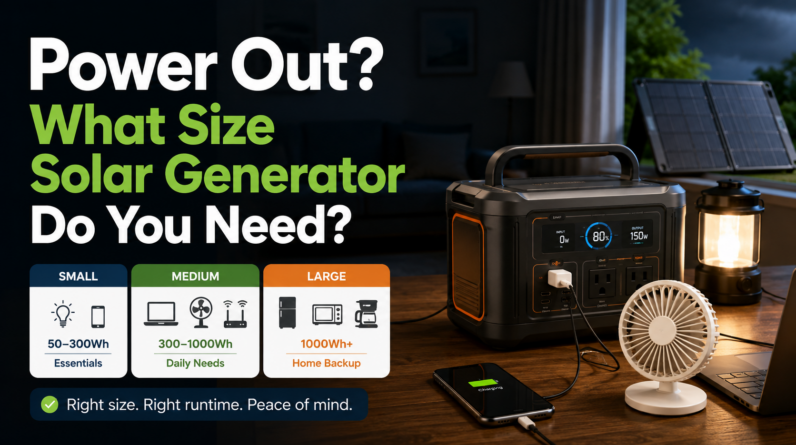
300Wh to 500Wh
Good for:
- Phones
- Tablets
- LED lights
- Small fans
- Radios
- Laptops
- Internet equipment
This size is best for basic electronics and short outages.
500Wh to 1,000Wh
Good for:
- Phones
- Laptops
- Lights
- Fans
- Router and modem
- Television
- CPAP machine
- Small refrigerator for limited periods
This range works well for people who want more than simple phone charging but do not need to run large household appliances.
1,000Wh to 2,000Wh
Good for:
- Refrigerator
- Freezer
- CPAP machine
- Electronics
- Lights
- Fans
- Small kitchen appliances
- Multiple devices
This is a popular range for emergency home backup because it can support several important devices at the same time.
2,000Wh and Above
Good for:
- Longer outages
- Refrigerators and freezers
- Medical equipment
- Larger appliances
- Multiple household devices
- Higher daily energy use
Large solar generators may also support expansion batteries, giving you much more stored energy.
How Do You Calculate the Solar Generator Size You Need?
The easiest way is to make a list of everything you want to power.
Write down:
- The wattage of each device
- How many hours per day you expect to use it
- The number of days you want backup power
Then calculate watt-hours.
The basic formula is:
Watts × Hours Used = Watt-Hours
If a device uses 50 watts and runs for 5 hours:
50 × 5 = 250Wh
That device would use about 250 watt-hours of energy.
Do this for each device and add the numbers together.
Example Power Outage Calculation
Suppose you want to run these devices during a blackout:
- Refrigerator: 700Wh per day
- Four LED lights: 120Wh per day
- Two phones: 30Wh per day
- Wi-Fi router: 100Wh per day
- Laptop: 120Wh per day
- Fan: 200Wh per day
Your estimated daily use would be:
1,270Wh per day
A 1,500Wh solar generator might cover roughly one day of this usage before losses are considered.
If you have solar panels that can recharge the generator during the day, you may be able to stretch that battery much longer.
Do Not Expect to Use 100% of the Battery Capacity
A solar generator labeled 1,000Wh does not necessarily give you exactly 1,000Wh of usable AC electricity.
Some energy is lost when the battery converts stored DC power into AC power.
You may also lose some energy through cables, charging electronics, and the inverter.
For planning purposes, it is smart to leave some room.
If your calculations show that you need 900Wh, buying a generator with exactly 900Wh of capacity may leave you short.
A larger unit gives you a buffer.
What Size Solar Generator Do I Need for a Refrigerator?
A refrigerator is one of the first appliances many people want to keep running during an outage.
A typical refrigerator may use somewhere around several hundred to more than 1,000 watt-hours per day depending on:
- Refrigerator size
- Age
- Efficiency
- Room temperature
- How often the door is opened
- Freezer settings
The refrigerator does not run continuously.
Its compressor cycles on and off throughout the day.
A solar generator around 1,000Wh or larger can be a reasonable starting point for refrigerator backup, but you need to check your refrigerator’s actual power requirements.
You also need enough inverter output to handle the compressor’s startup surge.
What Size Solar Generator Do I Need for a Freezer?
Freezers can be surprisingly efficient because they stay closed for long periods.
However, their energy use varies.
A chest freezer may require less electricity than a large upright freezer.
For basic freezer backup, a solar generator in the 1,000Wh range or larger may work, depending on the freezer.
If you are trying to keep both a refrigerator and freezer running, consider moving into the 1,500Wh to 2,000Wh range.
What Size Solar Generator Do I Need for a CPAP Machine?
Many CPAP machines use relatively little electricity compared with large appliances.
However, heated humidifiers and heated tubing can increase power consumption.
A smaller 300Wh to 500Wh power station may be enough for one night with some CPAP machines.
For multiple nights, a 500Wh to 1,000Wh solar generator may be more useful.
Always check the wattage of your specific machine.
If the CPAP is medically necessary, build extra battery capacity into your emergency plan rather than calculating for the absolute minimum.
What Size Solar Generator Do I Need for a TV?
Most modern televisions do not require enormous amounts of electricity.
A television might use roughly 50 to 200 watts depending on its size and technology.
If a TV uses 100 watts and you watch it for three hours:
100 watts × 3 hours = 300Wh
That is already a large percentage of a small 500Wh solar generator.
During a long blackout, television use may not be the best use of limited battery capacity.
What Size Solar Generator Do I Need for Wi-Fi?
A modem and router often use fairly little electricity.
Combined usage might be somewhere around 10 to 30 watts.
If the equipment uses 20 watts for eight hours:
20 × 8 = 160Wh
A small solar generator can usually handle this without much trouble.
Keep in mind that your internet provider may also lose power during a widespread outage.
Your router can be running perfectly while the outside internet connection is unavailable.
What Size Solar Generator Do I Need for Lights?
LED lights use very little electricity.
A 10-watt LED bulb running for five hours uses:
10 × 5 = 50Wh
Four bulbs would use about:
200Wh
That makes LED lighting one of the easier things to support with a small solar generator.
During an emergency, use only the lights you need instead of trying to light the entire house.
Can a Solar Generator Run a Microwave?
Many solar generators can run a microwave if the inverter is powerful enough.
Microwaves can use 1,000 watts or more.
That means a small solar generator may not be able to run one at all.
Even if your generator can power the microwave, it will use battery energy quickly.
For example, a microwave drawing 1,200 watts for 10 minutes would use approximately:
200Wh
Short microwave use can still be practical with a larger power station.
Can a Solar Generator Run a Coffee Maker?
Possibly.
Coffee makers can draw surprisingly high wattage.
Some use around 800 to 1,500 watts while brewing.
You need a solar generator with enough inverter capacity to support that power demand.
Because coffee makers run for only a short time, the total battery consumption may not be enormous.
Still, a 300-watt power station will not run a 1,000-watt coffee maker simply because the battery has enough stored energy.
The inverter output must also be high enough.
Can a Solar Generator Run an Air Conditioner?
Air conditioners are much harder to power.
Even a small window air conditioner may use hundreds of watts continuously and require a substantial startup surge.
Central air conditioning can require several thousand watts.
A small portable solar generator is usually not suitable for running whole-house air conditioning.
Some larger solar generators can run small window or portable AC units for limited periods.
If air conditioning is a major priority, you may need:
- A large-capacity solar generator
- Expansion batteries
- High inverter output
- Several solar panels
- Careful energy management
Fans use much less electricity and can be a better option during many outages.
What About a Space Heater?
Space heaters are another difficult appliance to run from batteries.
Many electric space heaters use around 1,500 watts.
A 1,500Wh solar generator could theoretically supply that amount of energy for about an hour before efficiency losses.
That makes electric heating a very heavy load.
If your emergency plan includes heating, a battery generator may not be the most practical primary source.
How Much Solar Panel Capacity Do You Need?
Battery size is only one part of the equation.
Solar panels determine how quickly you can put energy back into the battery.
Suppose your generator has a 1,000Wh battery.
A 100-watt solar panel will not normally recharge it in 10 hours exactly because real-world solar output is lower than the panel’s maximum rating.
A 200-watt or 400-watt panel setup can make a much larger solar generator more useful during extended outages.
The faster you can recharge the battery during daylight, the less stored battery capacity you may need.
Is a 500Wh Solar Generator Enough for a Power Outage?
For a short outage, it can be.
A 500Wh unit can be useful for:
- Charging phones
- Running LED lights
- Powering a router
- Charging laptops
- Running a fan
- Operating some CPAP machines
It will be much more limited if you want to run a refrigerator continuously.
Think of a 500Wh generator as a good electronics backup rather than full household backup.
Is a 1,000Wh Solar Generator Enough?
For many people, 1,000Wh is a useful middle ground.
It may run:
- Refrigerator
- Phones
- Lights
- Internet equipment
- Laptops
- CPAP machine
- Fans
You will still need to ration power during an extended blackout.
If you have enough solar panels to recharge it each day, a 1,000Wh generator becomes much more capable.
Is a 2,000Wh Solar Generator Enough?
A 2,000Wh solar generator gives you much more flexibility.
It can support higher daily energy use and more appliances.
This size is a good option for households that want to keep a refrigerator running while also powering electronics, lights, medical devices, and occasional kitchen appliances.
A 2,000Wh system with good solar input can provide meaningful emergency backup during a multi-day outage.
How Long Will a Solar Generator Last During an Outage?
That depends entirely on your energy use.
A 1,000Wh generator could last several days if you are only charging phones and running a few lights.
The same generator may last less than a day if you are powering a refrigerator, television, fan, computers, and other appliances.
You can make your battery last longer by cutting unnecessary loads.
During an outage:
- Turn off devices you are not using
- Use LED lights
- Limit television use
- Keep refrigerator doors closed
- Charge phones only when needed
- Use fans instead of air conditioning when possible
- Recharge with solar panels during daylight
Energy conservation can be just as valuable as buying a larger battery.
Should You Buy a Larger Solar Generator Than You Need?
Usually, some extra capacity is helpful.
Your actual energy usage may be higher than your calculations.
Solar conditions may also be poor.
Cloudy weather can make recharging slower.
A reasonable safety margin gives you extra power when conditions are not ideal.
If your estimated daily usage is 1,000Wh, you might consider a generator with 1,500Wh or more of capacity rather than buying the smallest system that technically meets your calculation.
Portable Solar Generator or Whole-House Backup?
Portable solar generators are excellent for selected emergency loads.
They are designed to run the devices and appliances you choose.
Whole-house battery backup is a different category.
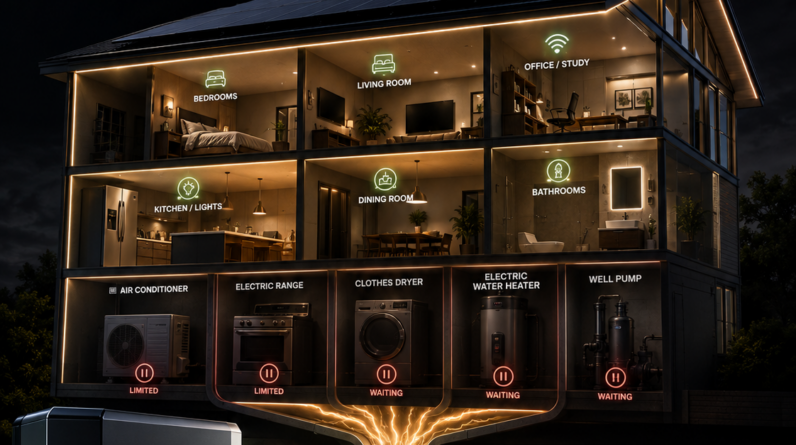
A large home battery system may connect directly to your electrical panel and automatically power part or all of the home during an outage.
These systems can provide far more energy, but they also cost considerably more and may require professional installation.
For many households, a portable solar generator offers a less expensive way to keep essential devices operating.
A Simple Way to Choose Your Size
If you do not want to calculate every watt, use this rough guide.
Basic Emergency Charging
Choose around 300Wh to 500Wh.
Best for phones, lights, laptops, radios, and internet equipment.
Essential Home Backup
Choose around 1,000Wh to 1,500Wh.
Best for a refrigerator plus several smaller devices.
Extended Outage Backup
Choose around 2,000Wh or more.
Best for multiple appliances, longer outages, and households that want more flexibility.
Heavy Appliance Backup
Look at 2,000Wh to 5,000Wh or expandable systems.
This is more appropriate if you want to run higher-power appliances or need large amounts of stored energy.
Frequently Asked Questions
How big of a solar generator do I need for a power outage?
For basic electronics, 300Wh to 500Wh may be enough. For refrigerators and several household devices, 1,000Wh to 2,000Wh is a more useful range. Longer outages may require 2,000Wh or more.
Is 1,000 watts enough for a solar generator?
It depends on whether you mean battery capacity or inverter output. A 1,000Wh battery can provide useful emergency power, while a 1,000-watt inverter determines which appliances can run at the same time.
Can a solar generator power a whole house?
Small portable models generally cannot. Large expandable battery systems may power many household circuits, but whole-house backup requires considerably more capacity.
How many solar panels do I need for an emergency generator?
That depends on the generator’s solar input limit, battery capacity, sunlight, and how quickly you need to recharge it. Larger battery systems generally benefit from larger solar arrays.
What size solar generator will run a refrigerator and freezer?
A 1,500Wh to 2,000Wh unit can be a good starting point for running both, but actual energy usage and startup requirements should be checked before buying.
Is it better to have two smaller solar generators or one large one?
Two units can give you redundancy and portability. One large unit may support higher-powered appliances and provide more convenient centralized backup. The better option depends on your emergency plan.
Choosing the Right Solar Generator for Your Home
The best solar generator is not necessarily the biggest one you can afford.
It is the one that can power the things you actually need during an outage.
For basic phone charging, lights, and internet access, a small 300Wh to 500Wh unit may be enough.
If you want refrigerator backup and room for several additional devices, look toward the 1,000Wh to 2,000Wh range.
For multi-day outages, larger systems with expansion batteries and substantial solar-panel capacity provide more flexibility.
Before buying anything, make a list of the appliances you want to run and calculate their estimated daily energy use.
That simple calculation can prevent you from buying a generator that is either too small or unnecessarily expensive.
This post contains Amazon affiliate links.