This post contains Amazon affiliate links.
Solar Charger for DEWALT 20V Batteries Review: A Handy Off-Grid Charging Option?
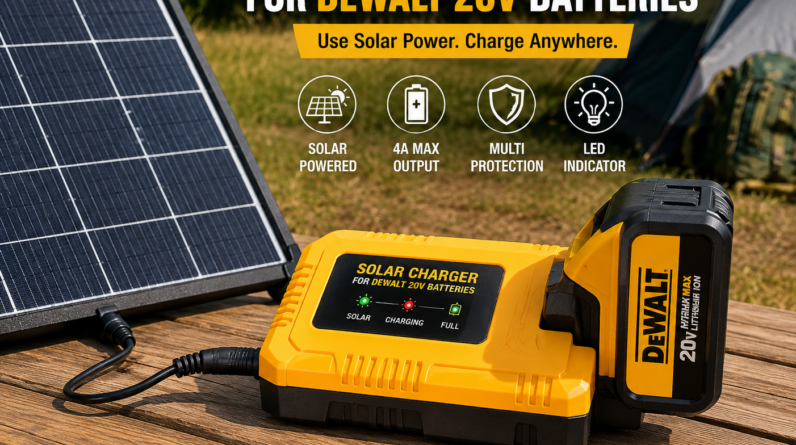
If you use DEWALT 20V batteries and spend a lot of time camping, working outdoors, traveling, or simply want another way to charge your batteries during a power outage, this Solar Charger for DEWALT 20V Batteries is an interesting little accessory.
Instead of requiring a standard 120V electrical outlet, this charger is designed to connect to a compatible solar panel and use that power to charge DEWALT-style lithium-ion batteries.
That could make it particularly useful for contractors, campers, RV owners, emergency-preparedness kits, and anyone who regularly works away from electrical outlets.
There is one major thing you need to know before buying it, though:
The solar panel is not included.
Here’s a closer look at how this charger works, what I like about it, and where I think buyers need to be careful.
Quick Verdict
This solar charger fills a pretty specific need, but it’s a clever accessory if that need matches your situation.
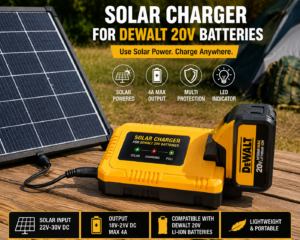
Compatible versions of this charger are designed for DEWALT 20V lithium-ion batteries, with a solar input range of approximately 22V to 30V and charging output of up to 4 amps. Similar listings specify an output range of roughly 18V to 21V.
The charger also uses solar charging circuitry designed to make better use of the changing power available from a solar panel.
For someone who already owns DEWALT batteries and a suitable solar panel, that’s a very convenient combination.
My biggest hesitation is that this is a third-party accessory rather than an official DEWALT charger. I’d be more cautious about battery compatibility, charging temperatures, and following the manufacturer’s input requirements.
My rating: 4.0 out of 5
What Does This Solar Charger Actually Do?
The concept is fairly simple.
You connect a compatible solar panel to the charger’s DC input and slide your DEWALT battery onto the charger.
The charger then regulates the solar panel’s output so it can charge the battery.
Compatible listings specify:
Solar input of approximately 22V to 30V
Battery charging output of approximately 18V to 21V
Maximum charging current of 4 amps
Compatibility with a range of DEWALT 20V MAX batteries
Automatic charging control
LED charging indicators
That makes it considerably different from simply attaching a solar panel directly to a tool battery, which you should not do.
What I Like
Charge DEWALT Batteries Without a Wall Outlet
This is the main reason to buy it.
Normally, charging your DEWALT batteries means finding an electrical outlet and using a standard AC charger.
With this adapter and a suitable solar panel, you’re no longer completely dependent on grid electricity.
That makes it useful for:
Camping
RV trips
Remote job sites
Hunting cabins
Workshops without electricity
Emergency preparedness
Power outages
Off-grid projects
For a contractor working somewhere without convenient AC power, being able to recharge batteries from a portable solar panel could be particularly useful.
Compatible With Popular DEWALT 20V Batteries
Comparable listings advertise compatibility with common DEWALT 20V MAX battery models including the DCB200, DCB201, DCB203, DCB204, DCB206, and DCB207. Some versions also list FLEXVOLT models such as the DCB606 and DCB609.
That means someone who already has several DEWALT batteries may be able to use the batteries they already own.
You don’t need to invest in a completely different battery ecosystem just to create a small solar charging setup.
Up to 4-Amp Charging
The listed maximum charging output is 4 amps, which is respectable for a compact solar battery charger.
Actual charging speed will depend heavily on your solar panel, sunlight, battery capacity, temperature, and how much power the panel is producing.
That’s an important distinction.
A 4-amp rating doesn’t mean you’ll continuously get 4 amps whenever the sun is visible. Solar output can change throughout the day.
Still, having the ability to deliver as much as 4 amps under suitable conditions gives the charger useful potential.
Solar Power Management Is Built In
The charger is described as using MPPT solar charging with PWM step-down operation to manage the changing output coming from a solar panel.
In simple terms, the charger sits between the solar panel and your DEWALT battery and manages the power being sent to the battery.
That is much better than treating a tool battery as something you can simply connect directly to a random solar panel.
Multiple Charging Stages
Comparable versions advertise an automatic charging sequence that moves through different charging stages rather than continuously dumping the same amount of power into the battery.
The charger also uses LED indicators to show charging status.
You insert the battery, connect the compatible solar source, and the indicator lets you know whether charging is taking place or has been completed.
It’s a simple setup, which is exactly what I’d want from this type of accessory.
Built-In Protection Features
The charger is advertised with circuitry designed to protect against problems including:
Overheating
Short circuits
Excessive charging time
Certain damaged battery conditions
Those are reassuring features to see on a lithium-ion battery charger.
That said, this is still a third-party device, so I would follow its instructions closely and avoid leaving the setup unattended for long periods.
Small and Portable
One of the biggest advantages compared with building a larger solar generator system is size.
Comparable units weigh only around half a pound and measure roughly 5 inches across.
Throw the charger into a toolbox or camping equipment bag along with a folding solar panel and you’ve got a fairly compact off-grid charging system.
For someone trying to travel light, that’s appealing.
What I Don’t Like
The Solar Panel Is Not Included
This is probably the biggest source of confusion.
You’re buying the charger, not an entire solar charging kit.
You’ll still need a compatible solar panel.
And you can’t necessarily grab just any panel.
The comparable charger specifications call for approximately 22V to 30V DC input, so you need to pay attention to your panel’s actual electrical specifications rather than simply buying something labeled “solar panel.”
I’d check the panel’s open-circuit voltage and recommended charger input specifications before connecting anything.
It’s Not an Official DEWALT Charger
Despite being designed for DEWALT batteries, this appears to be a third-party accessory rather than a DEWALT-manufactured charger.
DEWALT’s official charger catalog includes its own AC, vehicle, USB-C, and multiport charging products, but this solar adapter is not listed among DEWALT’s official chargers.
That doesn’t automatically make it bad.
There are plenty of useful third-party accessories for power tools.
It does mean I’d be more cautious than I would be with an official DEWALT charger.
Solar Charging Isn’t Consistent
Solar power sounds simple until clouds roll in.
Charging performance will depend on:
Solar panel wattage
Panel voltage
Direct sunlight
Panel orientation
Time of day
Weather
Battery capacity
Battery temperature
So don’t expect the same predictable charging speed you’d get by plugging a DEWALT charger into a wall outlet.
Think of this more as an off-grid charging solution than a replacement for your normal charger.
You Need the Right Solar Panel
This deserves repeating.
The input voltage matters.
Comparable versions specify approximately 22V to 30V input.
Using a panel that doesn’t meet the charger’s requirements could result in poor charging performance or potentially damage the equipment.
I’d pair the charger with a panel whose electrical output clearly falls within the charger’s stated input range.
Temperature Matters
Comparable product documentation specifies a charging temperature range of roughly 14°F to 122°F (-10°C to 50°C) and recommends allowing hot batteries to cool before charging.
That’s particularly relevant because this charger is intended for outdoor use.
If a battery has been sitting inside a hot truck or baking in direct sunlight, I’d let it cool before putting it on the charger.
Likewise, extremely cold conditions aren’t ideal for charging lithium-ion batteries.
How Fast Will It Charge a DEWALT Battery?
There’s no single answer because solar conditions vary so much.
The charger has a maximum listed output of about 4 amps, but you’ll only approach that when your solar panel can provide enough power under suitable conditions.
A small solar panel on an overcast afternoon will charge significantly slower than a properly sized panel sitting in direct midday sun.
Battery capacity also makes a big difference.
A 2Ah battery contains considerably less energy than a 5Ah, 6Ah, or 9Ah pack.
I wouldn’t buy this based on a promise of a specific charging time.
I’d buy it because it gives you the ability to recharge batteries where an AC outlet simply isn’t available.
Who Is This Best For?
Contractors
If you regularly work on remote properties, new construction sites, farms, or other locations where electrical service isn’t available yet, this could be handy.
Campers and RV Owners
A portable solar panel combined with your existing DEWALT batteries gives you another way to keep your tools and battery-powered equipment running.
People With Off-Grid Workshops
If you’ve got a shed, barn, garage, or workshop that doesn’t have electricity, solar charging may be considerably easier than running permanent electrical service.
Emergency Preparedness
If the power goes out for several days, DEWALT batteries can be surprisingly useful.
Pair them with USB adapters, lights, fans, radios, and other battery-powered equipment and they become part of an emergency power setup.
A solar charger gives you a way to replenish those batteries even if the electrical grid is unavailable.
Who Should Skip It?
I wouldn’t recommend this charger if you’re simply looking for the fastest or easiest way to charge DEWALT batteries at home.
Use a normal DEWALT wall charger for that.
I also wouldn’t buy it unless you’re comfortable checking the electrical specifications of your solar panel.
And if you want a completely plug-and-play solar system with a large battery, AC outlets, USB ports, and solar charging already integrated, a portable power station might make more sense.
This product is better suited to someone who specifically wants to turn their existing DEWALT batteries into part of an off-grid setup.
Pros and Cons
Pros
Charges compatible DEWALT 20V batteries using solar power
Doesn’t require a standard AC outlet
Maximum output of approximately 4 amps
Compact and lightweight
Useful for camping and remote job sites
Makes good use of batteries you already own
Solar power management is built into the charger
LED charging indicators
Advertised overheating and short-circuit protection
Useful addition to an emergency kit
Cons
Solar panel isn’t included
Third-party product rather than an official DEWALT charger
Requires a solar panel with the correct voltage range
Charging speed depends heavily on sunlight
Battery temperature affects charging
Less convenient than a standard wall charger for everyday use
Product instructions and labeling can be less polished than DEWALT’s own accessories
Is This DEWALT Solar Battery Charger Worth Buying?
If you already have a collection of DEWALT 20V batteries and a compatible solar panel, I think this is one of those inexpensive accessories that could turn out to be surprisingly useful.
It’s not something I’d use as my primary battery charger.
That’s not really its purpose.
The appeal is being able to take a DEWALT battery, a portable solar panel, and this small charger somewhere miles away from the nearest electrical outlet and still have a way to replenish your batteries.
That’s useful for camping.
It’s useful on remote job sites.
And it could be very useful during an extended power outage.
The biggest caution is compatibility. Make sure your solar panel falls within the charger’s specified input range, verify your particular DEWALT battery is supported, and remember that this is a third-party charger.
As long as you understand those limitations, this solar charger is a clever and affordable way to add off-grid charging capability to your DEWALT battery collection.
Looking for a Power Inverter?
Overall Rating: 4.0/5
This post contains Amazon affiliate links.