This post contains Amazon affiliate links.
A solar generator can keep a refrigerator running during a power outage, but the runtime can vary a lot.
A small battery may keep a fridge going for only a few hours.
A larger 1,000Wh to 2,000Wh power station may run an efficient refrigerator much longer, especially if the compressor cycles on and off instead of running continuously.
The biggest factors are:
- Battery capacity
- Refrigerator energy use
- Compressor startup surge
- Inverter efficiency
- Room temperature
- How often you open the door
- Whether you can recharge with solar
A simple way to estimate runtime is:
Usable battery watt-hours ÷ average refrigerator watts = approximate runtime
That gives you a rough starting point.
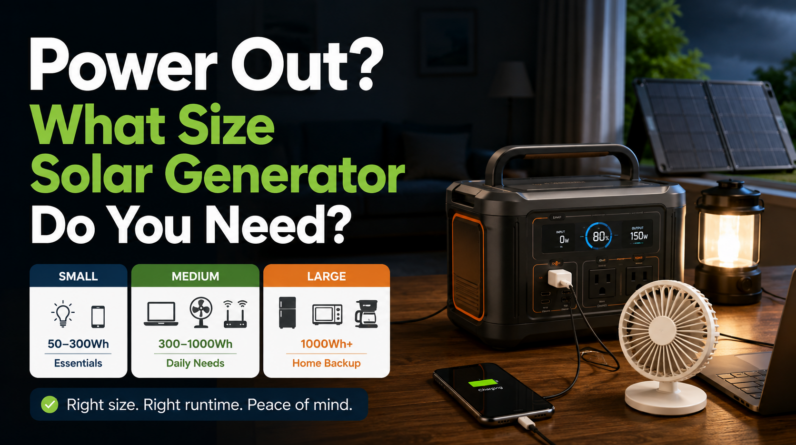
If you are still choosing a battery, see What Size Solar Generator Do I Need for a Power Outage?.
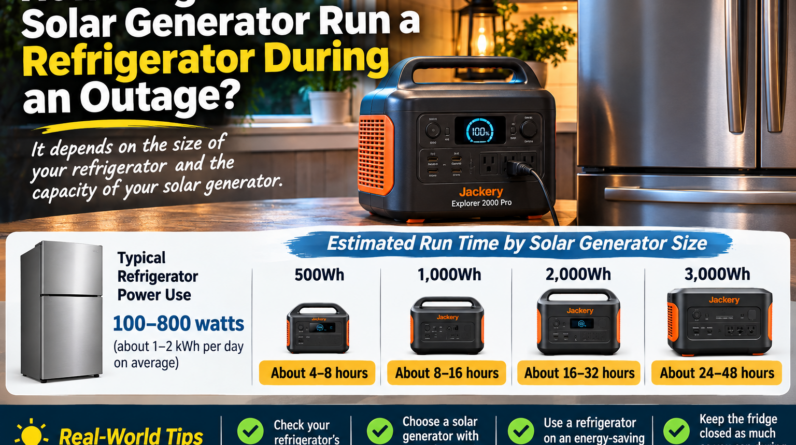
Quick Refrigerator Runtime Table
| Solar Generator Size | Rough Refrigerator Runtime |
|---|---|
| 300Wh | A few hours |
| 500Wh | Several hours |
| 1,000Wh | Roughly half a day to a full day for many efficient fridges |
| 2,000Wh | Around a day or more in many setups |
| 3,000Wh+ | Potentially multiple days, especially with solar recharging |
These are general estimates.
Your refrigerator may use much more or much less electricity.
How Much Power Does a Refrigerator Use?
A refrigerator does not run at full power all day.
The compressor turns on when cooling is needed, then shuts off once the inside reaches the set temperature.
That cycling behavior is why looking only at running watts can be misleading.
A refrigerator might draw a few hundred watts while the compressor is active, yet use much less energy averaged over 24 hours.
The number that matters most for backup planning is daily watt-hour consumption.
Where Can You Find Your Refrigerator’s Power Use?
Check:
- Energy label
- Manufacturer specifications
- Power meter
- Appliance manual
A plug-in power meter can give you a much better real-world number than guessing.
Measure the refrigerator over 24 hours if possible.
That tells you how much energy it actually uses in your home.
Why Daily Energy Use Matters More Than Running Watts
Suppose your refrigerator draws 150 watts while running.
That does not mean it uses:
150 × 24 = 3,600Wh per day
because the compressor is not running constantly.
If it only runs part of the time, daily consumption may be far lower.
That is why battery runtime should be based on actual energy use rather than maximum running power alone.
What Is Compressor Startup Surge?
Refrigerators can briefly draw much more power when the compressor starts.
That is called startup surge.
Your power station needs enough inverter capacity to handle that short burst.
A battery may have plenty of stored energy but still fail to start a refrigerator if the inverter is too weak.
When choosing a solar generator, check:
- Continuous output
- Surge output
- Battery capacity
All three matter.
Can a 300Wh Solar Generator Run a Refrigerator?
Possibly, but only for a limited period.
A 300Wh battery may keep an efficient refrigerator running for a few hours.
It may not have enough reserve to make it through the night.
This size is better suited to:
- Phones
- Lights
- Router
- Laptop
- Small electronics
If refrigeration is a priority, a larger battery is usually more practical.
Can a 500Wh Solar Generator Run a Refrigerator?
Yes, in many cases.
A 500Wh power station may provide several hours of refrigerator backup.
For a highly efficient refrigerator, you may get more.
For an older or larger model, you may get less.
A 500Wh unit can work well for a short outage, but it may feel limited during a full-day blackout.
Can a 1,000Wh Solar Generator Run a Refrigerator?
A 1,000Wh power station is a much more useful size for refrigerator backup.
Suppose your refrigerator uses about 700Wh per day.
A 1,000Wh battery may get you close to a full day before losses, depending on the refrigerator and conditions.
Real usable energy is lower than the battery’s printed capacity.
Inverter losses and other system overhead reduce runtime.
Can a 2,000Wh Solar Generator Run a Refrigerator?
Yes.
A 2,000Wh battery gives you much more breathing room.
If your refrigerator uses around 700Wh per day, a 2,000Wh power station could theoretically cover more than two days before losses.
Actual runtime will be lower.
Still, this size can provide strong refrigerator backup during a multi-day outage.
Can a 3,000Wh Solar Generator Run a Refrigerator for Several Days?
Often, yes.
A 3,000Wh battery can support an efficient refrigerator for multiple days, especially if you reduce unnecessary power use.
If you also connect solar panels, the system becomes much more useful for long outages.
The panels can replace some or all of the energy the refrigerator uses each day.
How Do You Calculate Refrigerator Runtime?
Use this basic formula:
Usable battery capacity ÷ average refrigerator power = runtime
For example, suppose your power station provides about 900Wh of usable energy and your refrigerator averages 60 watts over time.
900 ÷ 60 = 15 hours
That is only an estimate.
Real-world conditions can change the result.
Another Way to Calculate It
If you know daily energy use, the math is even easier.
Suppose your refrigerator uses 800Wh per day.
A 1,600Wh usable battery would theoretically provide:
1,600 ÷ 800 = 2 days
Again, actual runtime may be lower.
Why Usable Battery Capacity Is Lower Than Advertised Capacity
A 1,000Wh power station does not always deliver a full 1,000Wh through its AC outlets.
Some energy is lost through:
- Inverter conversion
- Internal electronics
- Standby power
- Cable losses
That is why it is smart to leave extra capacity in your calculations.
Does Room Temperature Affect Refrigerator Runtime?
Yes.
A refrigerator in a hot room has to work harder.
During a summer outage, indoor temperatures may rise quickly.
That can cause the compressor to run more often.
The same refrigerator may use considerably more electricity in a hot apartment than in a cool basement.
Does Opening the Refrigerator Door Matter?
Yes.
Every time you open the door, cold air escapes.
The compressor then has to run longer to cool the interior again.
During a blackout:
- Open the door only when necessary
- Decide what you need before opening it
- Close it quickly
This can help extend both food safety and battery runtime.
Should You Turn the Refrigerator Temperature Up?
You can sometimes reduce energy use by avoiding unnecessarily cold settings.
But do not raise the temperature so much that food safety becomes a concern.
Use a refrigerator thermometer if possible.
The goal is to reduce waste without allowing food to become unsafe.
Can You Run a Refrigerator and Freezer From One Solar Generator?
Yes, if the power station is large enough.
You need to account for:
- Combined daily energy use
- Combined startup surge
- Other household loads
Suppose:
- Refrigerator uses 700Wh per day
- Freezer uses 500Wh per day
Combined:
1,200Wh per day
A 1,000Wh battery would not last a full day.
A 2,000Wh or larger system would be more realistic.
For more on emergency refrigeration, see Solar Generator for Emergency Food Preservation and Refrigerator Power.
Can Solar Panels Keep the Refrigerator Running Indefinitely?
Potentially, if daily solar production matches or exceeds daily refrigerator consumption.
That is the key.
If your refrigerator uses 800Wh per day and your panels produce 1,200Wh per day, you may be able to keep up.
If the panels produce only 400Wh per day, your battery will gradually drain.
Weather makes this unpredictable.
Is a 100W Solar Panel Enough for Refrigerator Backup?
It may help, but one 100W panel may not produce enough daily energy to fully replace what a refrigerator uses.
It can still slow battery depletion.
For smaller loads, see What Can a 100-Watt Solar Panel Power During an Emergency?.
Is a 200W Solar Panel Enough?
A 200W panel gives you a much better chance of replacing meaningful daily refrigerator use.
It may be enough for a highly efficient refrigerator under good sunlight.
See What Can a 200-Watt Solar Panel Power During an Emergency?.
Is 400W Better for Refrigerator Backup?
Yes.
A 400W solar array can produce enough electricity during a good day to support refrigeration plus smaller devices.
That gives you more margin for cloudy conditions and battery losses.
Our 400-watt solar panel emergency guide covers this in more detail.
What About 800W of Solar?
An 800W array can support much larger daily loads.
It may be able to cover:
- Refrigerator
- Freezer
- Phones
- Router
- Lights
- Laptop
during favorable weather.
Can You Run the Refrigerator Only Part of the Day?
Sometimes people try to save battery by cycling the refrigerator manually.
This can reduce energy use, but you need to be careful.
Food safety matters more than battery savings.
If you use this strategy, monitor interior temperature rather than guessing.
Should You Plug Other Devices Into the Same Solar Generator?
You can, but every device reduces refrigerator runtime.
For example, a 1,000Wh battery might also be powering:
- Router
- Phone
- Lights
- Fan
- Laptop
Those loads may seem small individually, but together they can consume a significant amount of energy.
Refrigerator vs Phone Charging
Phone charging uses very little electricity compared with refrigeration.
You can usually charge several phones without making a huge dent in a large battery.
For a phone-specific plan, see How to Keep Your Phone Charged During a 3-Day Power Outage.
Refrigerator vs Fan
Fans can be moderate loads.
A 40-watt fan running for eight hours uses:
320Wh
That is enough to noticeably reduce refrigerator runtime.
During a hot outage, you may have to balance food protection against comfort.
Refrigerator vs Wi-Fi
A modem and router usually consume much less electricity than a refrigerator.
Still, leaving them on around the clock can add up.
If battery capacity is tight, turn off internet equipment when you are sleeping or not using it.
Refrigerator vs Microwave
A microwave uses high wattage but runs for only short periods.
A 1,200-watt microwave running for 10 minutes uses about:
200Wh
That is a meaningful chunk of a small battery.
During an outage, microwave use can reduce refrigerator runtime quickly.
Refrigerator vs Coffee Maker
Coffee makers also draw high wattage.
They may not run long, but repeated use adds up.
If preserving food is your top priority, save high-power kitchen appliances for when you have plenty of battery reserve.
How Long Will a Solar Generator Run a Refrigerator Overnight?
A 1,000Wh power station may be able to run an efficient refrigerator overnight.
A 500Wh unit may or may not make it through the night, depending on the appliance.
A 2,000Wh battery gives you much more confidence.
The best way to know is to test it before an emergency.
Test Your Refrigerator Before the Power Goes Out
This is one of the best things you can do.
Plug your refrigerator into the solar generator while grid power is still available.
Let it run for several hours or overnight.
Check how much battery capacity is left.
That gives you a real-world number based on your exact appliance.
Do Not Wait Until the Outage to Test It
You do not want to discover during a blackout that:
- The inverter cannot handle startup surge
- The battery drains too quickly
- The cord does not reach
- The solar input is incompatible
- The power station shuts down unexpectedly
Testing beforehand removes a lot of uncertainty.
How Can You Make the Battery Last Longer?
A few simple steps can stretch refrigerator runtime.
Keep the Door Closed
Open it as little as possible.
Start With a Cold Refrigerator
If severe weather is expected, make sure the fridge is fully cooled beforehand.
Freeze Extra Water Bottles
Frozen water can help stabilize temperature.
Reduce Other Loads
Avoid running unnecessary devices from the same battery.
Use Solar During Daylight
Recharge while the sun is available.
Keep the Refrigerator in a Cooler Environment
If possible, keep indoor temperatures from climbing excessively.
Should You Use Eco Mode on the Solar Generator?
Some power stations include power-saving modes.
These may reduce standby consumption.
Check whether eco mode is compatible with refrigerator operation.
Some energy-saving features may shut off AC output if they think the load is too low.
Test before relying on it.
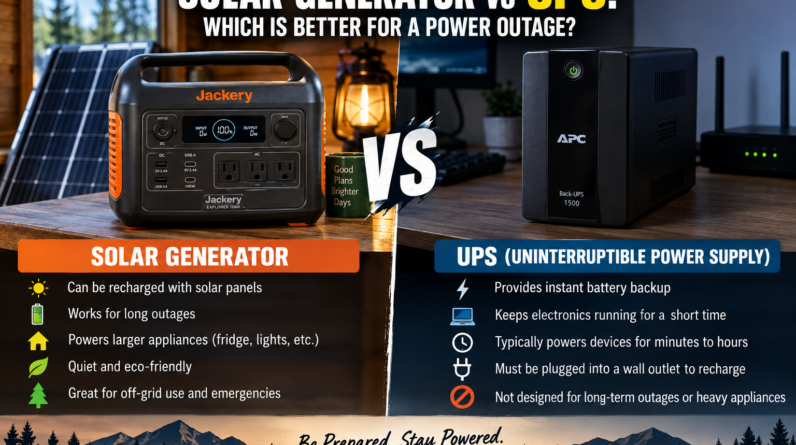
Is a Solar Generator Better Than a UPS for a Refrigerator?
Usually, yes.
A UPS is designed mainly for short-term backup of electronics.
A solar generator generally has much more battery capacity and higher inverter output.
Is a Solar Generator Good for Apartment Refrigerator Backup?
Yes.
Battery power stations are especially useful in apartments because they do not produce engine exhaust.
A 1,000Wh or larger unit can provide meaningful refrigerator backup.
See Best Solar Backup Power Setup for Apartment Dwellers for a full small-space setup.
What Size Solar Generator Is Best for Refrigerator Backup?
A good starting point is often:
500Wh: short outages
1,000Wh: stronger short-term refrigerator backup
2,000Wh: longer outages and extra devices
3,000Wh+: multi-day backup with larger energy reserves
Your refrigerator’s actual energy use should determine the final size.
What If the Power Outage Lasts 3 Days?
For a three-day outage, solar recharging becomes very useful.
A battery alone may not last long enough.
A battery plus solar panels can potentially operate much longer.
For example:
Day 1: Refrigerator runs from battery.
Day 2: Solar replenishes part of the battery while the refrigerator continues running.
Day 3: Repeat the cycle.
If daily solar production keeps up with daily consumption, your system can continue much longer.
What If It Is Cloudy for Several Days?
This is where extra battery capacity matters.
If solar production is poor, your battery may gradually lose charge.
A larger battery gives you a cushion.
You can also reduce loads and prioritize refrigeration.
Frequently Asked Questions
How long will a 1,000Wh solar generator run a refrigerator?
For many efficient refrigerators, it may provide around half a day to a full day of backup, but actual runtime depends on appliance energy use and system losses.
How long will a 2,000Wh power station run a refrigerator?
It may run an efficient refrigerator for around a day or more, and sometimes considerably longer. Measure your refrigerator’s daily watt-hour use for a better estimate.
Can a 500Wh power station run a refrigerator overnight?
Possibly. Some efficient refrigerators may make it through the night, while others may drain the battery sooner.
Can a solar generator run a refrigerator for 3 days?
Yes, if the battery is large enough or solar panels replenish the energy used each day.
How many watts does a refrigerator use?
Running wattage varies widely. Daily watt-hour consumption is usually more useful for estimating backup runtime.
Can I run a refrigerator directly from solar panels?
Usually, a battery or solar generator is used between the panels and refrigerator. The battery handles startup surge and provides power when sunlight changes.
What size solar panel do I need for a refrigerator?
A 200W to 400W or larger solar array can be more practical for refrigerator backup than a single small panel. The right size depends on daily appliance consumption and local solar conditions.
How Long Should You Expect Your Refrigerator to Run?
There is no single runtime that applies to every refrigerator.
A small battery may last a few hours.
A 1,000Wh power station may provide much of a day.
A 2,000Wh or larger system can provide substantially more backup.
The best way to plan is to measure your refrigerator’s actual daily energy use, choose a power station with enough inverter capacity for startup surge, and leave room for efficiency losses.
If you want the system to operate through a multi-day outage, add enough solar capacity to replace a meaningful portion of the energy used each day.
This post contains Amazon affiliate links.