This post contains Amazon affiliate links.
Solar Generator vs UPS: Which Is Better for a Power Outage?
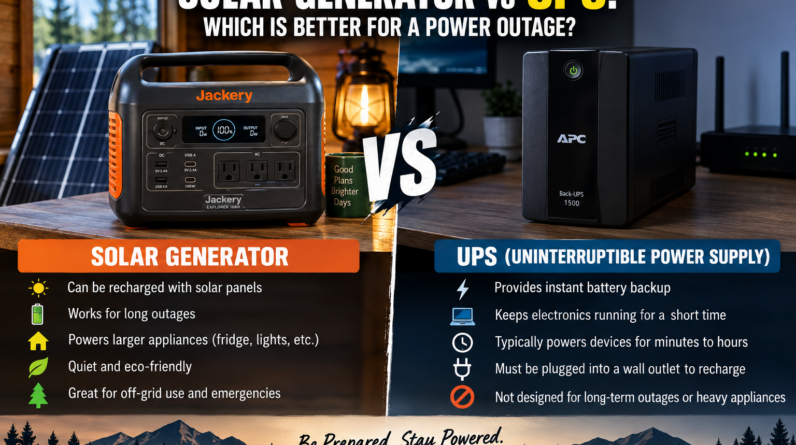
A UPS and a solar generator can both keep important devices running when the power goes out, but they solve different problems.
A UPS, or uninterruptible power supply, is designed to keep connected equipment running immediately when grid power fails. It is especially useful for computers, routers, modems, and other electronics that should not suddenly shut off.
A solar generator, more accurately called a portable power station, is designed to provide much more stored electricity for longer outages. It can often run laptops, lights, CPAP machines, refrigerators, fans, televisions, and other devices. Many models can also recharge from solar panels.
So which is better?
For a short outage where you mainly want to protect a computer or keep your internet equipment running, a UPS is often the better choice.
For longer outages, larger loads, or situations where you want the ability to recharge from sunlight, a solar generator is usually more useful.
What Is a UPS?
UPS stands for uninterruptible power supply.
It is a battery backup device that sits between a wall outlet and your electronics.
You plug the UPS into the wall.
Then you plug devices such as a computer, monitor, modem, or router into the UPS.
When electricity is available, your devices receive normal grid power and the UPS keeps its internal battery charged.
When the electricity suddenly goes out, the UPS switches to battery power almost immediately.
That fast transfer is the biggest advantage of a UPS.
For more on whether you even need a larger battery system during short blackouts, read Is a Solar Generator Necessary for Short Outages?.
What Is a Solar Generator?
A solar generator is essentially a large portable rechargeable battery with an inverter and multiple types of electrical outputs.
Depending on the model, you may have:
- Standard AC outlets
- USB-A ports
- USB-C ports
- 12-volt outlets
- DC outputs
- Solar charging inputs
Most solar generators can be recharged from:
- Wall outlet
- Vehicle
- Solar panels
Some can also recharge from other sources depending on the model.
Unlike a traditional gas generator, there is no engine and no fuel.
That means a solar generator is quiet and does not produce exhaust while operating.
Our article on the pros and cons of solar chargers compares battery and solar-based backup options with other common emergency power choices.
Solar Generator vs UPS: The Biggest Difference
The main difference is what each device is designed to do.
A UPS is designed for immediate backup.
A solar generator is designed for longer-term portable power.
Think of it this way.
A UPS says:
“The electricity just went out. I will keep your computer running long enough for you to continue working or shut it down safely.”
A solar generator says:
“The electricity may be out for hours or days. What devices do you want to keep powered?”
That difference affects nearly every other comparison.
Which One Responds Faster During an Outage?
A UPS generally wins.
UPS systems are specifically designed to switch to battery backup very quickly when grid power disappears.
That makes them useful for desktop computers and other equipment that should not suddenly lose electricity.
A portable power station may also include a UPS or EPS feature, but not every model behaves the same way.
Some power stations have transfer times that may be acceptable for certain electronics but not ideal for every sensitive device.
If uninterrupted computer operation is your main concern, a dedicated UPS is usually the safer choice.
Which Is Better for a Desktop Computer?
For protecting a desktop computer from a sudden shutdown, a UPS is usually better.
Suppose you are working on a document when the electricity goes out.
Without backup power, your computer shuts off immediately.
You could lose unsaved work or potentially create other problems.
A UPS provides battery power almost immediately.
Depending on its battery size and your computer’s power consumption, it may give you enough time to:
- Save your work
- Finish a short task
- Shut the computer down properly
- Continue working through a brief outage
A solar generator can run a desktop computer too, but automatic switchover depends on the model.
Which Is Better for a Laptop?
A laptop already contains its own battery.
That changes the equation.
If the power goes out, the laptop automatically switches to its internal battery.
Because of that, a UPS may not be necessary unless you also need to keep:
- External monitors
- Router
- Modem
- Desktop equipment
- Network hardware
A solar generator can be more useful for a laptop during a longer outage because it can recharge the laptop repeatedly.
A 100W, 200W, or larger solar panel can then replenish the power station during daylight.
If you are trying to estimate how much solar capacity you need, see What Can a 100-Watt Solar Panel Power During an Emergency? and What Can a 200-Watt Solar Panel Power During an Emergency?.
Which Is Better for Wi-Fi?
A UPS can be excellent for a modem and router.
Internet equipment usually draws relatively little electricity.
That means even a modest UPS may keep it operating through a short outage.
This can be extremely useful if your internet provider remains online.
For a brief blackout, a UPS is often simpler than dragging out a large battery station just to run a router.
For a longer outage, a solar generator becomes more attractive because it offers much more battery capacity and can potentially recharge from solar.
Can a UPS Keep Wi-Fi Running for Hours?
Possibly.
Runtime depends on:
- UPS battery capacity
- Router power consumption
- Modem power consumption
- Other connected equipment
If your router and modem together use relatively little electricity, a UPS may keep them running much longer than it would a desktop computer.
This is one reason a UPS can be such a practical tool for short outages.
Which Is Better for a Refrigerator?
A solar generator wins.
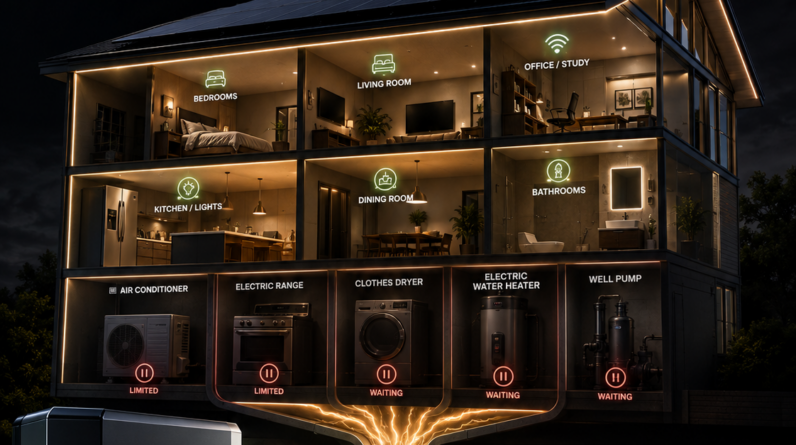
Most consumer UPS systems are not designed to run refrigerators.
Refrigerators require substantially more stored energy and have compressor startup surges.
A properly sized solar generator can handle those loads.
The battery can power the refrigerator while solar panels replenish some or all of the energy during the day.
If refrigerator backup is your priority, read Solar Generator for Emergency Food Preservation and Refrigerator Power.
Which Is Better for a Freezer?
Again, the solar generator.
A freezer generally requires much more battery capacity than a standard UPS is designed to provide.
A solar generator can also support the freezer for a longer period and potentially recharge from solar panels.
If you need to keep both a refrigerator and freezer operating during a long outage, consider a larger power station and more solar input.
Our 400-watt solar panel emergency guide explains why larger solar arrays become more useful once refrigeration enters the picture.
Which Is Better for a CPAP Machine?
For overnight use, a solar generator often provides more flexibility.
A CPAP machine needs enough stored battery capacity to run throughout the night.
Some UPS systems may work depending on the equipment and battery size, but portable power stations are commonly better suited to longer runtimes.
A solar generator can also be recharged during daylight.
If the CPAP is medically necessary, avoid choosing a system that barely meets your calculated energy requirement.
Extra battery capacity gives you protection against:
- Cloudy weather
- Unexpectedly high consumption
- Longer outages
- Charging problems
Which Is Better for Phones?
For phones alone, you may need neither.
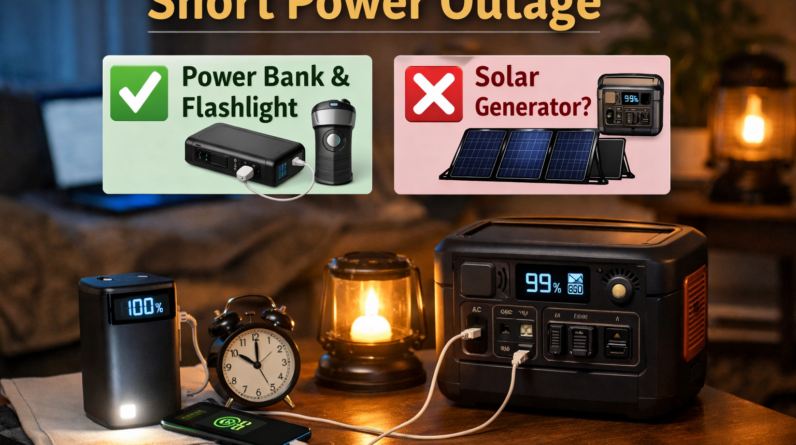
A regular power bank is often cheaper and easier.
A high-capacity USB power bank may provide multiple phone charges without the size or expense of either a UPS or solar generator.
For longer outages, a solar charger or solar generator gives you the ability to generate additional electricity.
See How to Keep Your Phone Charged During a 3-Day Power Outage for a simple multi-day phone charging plan.
Which Is Better for Multiple Devices?
A solar generator generally wins.
Portable power stations typically include several output ports.
You may be able to run:
- Phones
- Laptop
- Router
- Lights
- Fans
- Radio
at the same time.
A UPS can also power several devices, but its battery capacity is usually much more limited.
If your household has several devices that need charging, see Emergency Solar Chargers That Can Charge Multiple Devices.
How Long Does a UPS Last During a Power Outage?
UPS systems are generally intended for relatively short runtimes.
How long one lasts depends heavily on the load.
A UPS connected to a powerful desktop computer may provide only enough time to save your work and shut down.
The same UPS connected to a small router may last much longer.
This is why UPS runtime should always be evaluated based on what you actually plan to plug into it.
How Long Does a Solar Generator Last?
Potentially much longer.
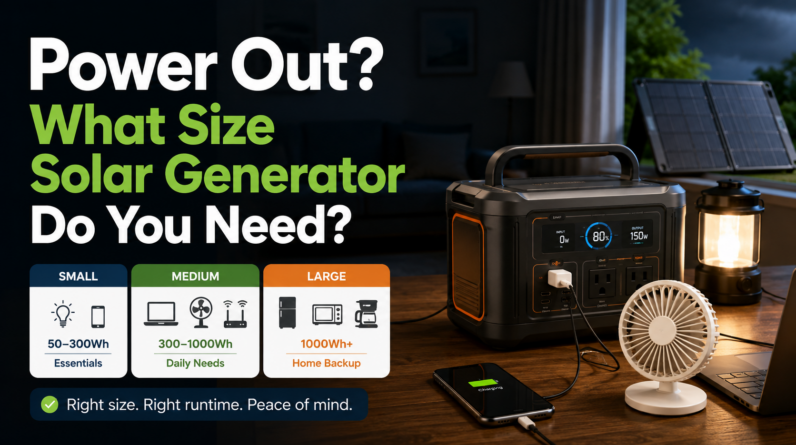
Solar generators come in battery capacities ranging from a few hundred watt-hours to several thousand watt-hours or more.
A small unit may handle phones and electronics.
A larger one may operate refrigeration and several household devices.
How long it lasts depends on:
Battery capacity ÷ device consumption
Suppose you have a 1,000Wh power station and a device averages 100 watts.
A simple theoretical calculation would be:
1,000Wh ÷ 100W = 10 hours
Actual runtime will be shorter because of inverter and system losses.
Which One Has More Battery Capacity?
Solar generators generally offer much larger battery capacities.
That is one of their major advantages.
UPS systems are commonly sized to bridge short interruptions.
Portable power stations are commonly sized to supply electricity for hours or days.
Some solar generators also support expansion batteries, allowing you to substantially increase stored energy.
Which One Can Recharge From Solar Panels?
Solar generators are the clear winner.
Solar charging is one of the features that makes them particularly useful during multi-day outages.
A battery alone eventually becomes empty.
Solar panels give you a way to create more electricity each day.
For example, you might pair a power station with:
- 100W solar panel
- 200W solar panel
- 400W solar array
- 800W solar array
The larger the panel setup, the faster you may be able to replace the energy you use.
You can compare these sizes in our guides to 100W emergency solar, 200W emergency solar, 400W emergency solar, and 800W emergency solar.
Can You Recharge a UPS With Solar?
Technically, certain setups may allow it, but a standard consumer UPS is usually not designed around direct solar charging.
You would need compatible equipment and a properly designed charging arrangement.
For most people who specifically want solar recharging, buying a portable power station designed to accept solar input is much simpler.
Which Is Better for an Overnight Outage?
It depends on your needs.
If you want to keep only:
- Router
- Modem
- Computer equipment
running, a UPS may be enough.
If you want:
- Refrigerator
- CPAP
- Fans
- Several lights
- Phones
- Laptop
a solar generator is more appropriate.
Which Is Better for a 1-Hour Outage?
Usually a UPS or power bank.
Buying a large solar generator only for occasional one-hour outages may be unnecessary.
A UPS can keep critical electronics online.
A power bank can take care of phones.
This is exactly why our guide Is a Solar Generator Necessary for Short Outages? recommends thinking about outage duration before buying expensive backup equipment.
Which Is Better for a 3-Hour Outage?
A UPS may still be enough for smaller loads.
However, a solar generator starts to make more sense if you want to run several devices or larger equipment.
For example, three hours without power could affect:
- Refrigerator
- Work equipment
- Medical equipment
- Fans
- Internet
- Lighting
A portable power station gives you more flexibility.
Which Is Better for a 12-Hour Outage?
A solar generator is generally much more useful.
A standard UPS may be depleted long before the outage reaches 12 hours.
A solar generator with sufficient capacity can continue operating essential devices throughout the outage.
If the outage extends into daylight, solar panels may provide additional energy.
Which Is Better for a 3-Day Outage?
The solar generator wins easily.
A UPS is not designed to serve as a complete multi-day emergency power source.
A solar generator paired with sufficient solar capacity can keep generating and storing electricity.
For a multi-day blackout, that difference is huge.
Your system could help support:
- Refrigerator
- Freezer
- Phones
- Lights
- Router
- Fans
- CPAP
- Laptop
- Radio
You will still need to ration electricity.
Does a Solar Generator Work Like a UPS?
Sometimes.
Some portable power stations include a UPS or EPS-style mode.
The power station stays connected to wall electricity and automatically switches to battery power when the grid fails.
This sounds similar to a regular UPS, but you need to check the specifications carefully.
Important questions include:
- What is the transfer time?
- Which outlets support backup mode?
- Is the feature rated for continuous use?
- Does the manufacturer call it UPS or EPS?
- Is it suitable for sensitive equipment?
Do not assume every solar generator is a direct replacement for a computer UPS.
What Is EPS Mode?
EPS usually means emergency power supply.
Some portable power stations use this term for automatic backup functionality.
The transfer may be slower than that of a dedicated UPS.
For refrigerators, lights, and many other appliances, that may not matter.
For sensitive computer or networking equipment, it might.
Always check the manufacturer’s transfer-time specifications for your specific equipment.
Which Is Better for Sensitive Electronics?
A quality UPS is usually the safer choice when seamless power continuity is the main concern.
UPS systems are specifically designed to protect electronics from interruptions.
Many also provide features such as:
- Surge protection
- Voltage regulation
- Power conditioning
- Automatic battery backup
Portable power stations focus more on energy storage and portability.
Some provide excellent backup functionality, but models vary.
Which Is More Portable?
A solar generator is designed to be portable, but that does not necessarily mean it is lightweight.
Small power stations may be easy to carry.
Large 2,000Wh or 3,000Wh models can be heavy.
UPS systems also vary in size, but they are usually designed to remain next to the equipment they protect.
They often do not have the carrying handles, outdoor features, and multiple charging options found on portable power stations.
Which Is Quieter?
Both are generally quiet because both rely on batteries rather than combustion engines.
You may hear cooling fans under heavier loads.
Neither produces the loud engine noise associated with gasoline generators.
This makes both options useful in apartments and other places where a fuel generator may not be practical.
Which Can Be Used Indoors?
Both.
Battery-based UPS systems and portable power stations do not produce engine exhaust during normal operation.
That gives them a major advantage over gasoline generators.
Fuel-powered generators should never be operated inside a home, garage, or other enclosed area because of carbon monoxide risk.
Which Is Cheaper?
A UPS is usually cheaper if your goal is simply protecting a computer or router for a short period.
Solar generators can cost considerably more because you are buying:
- Larger battery
- Inverter
- Multiple outlets
- Portable design
- Charging electronics
- Solar capability
Adding solar panels increases the total cost further.
The extra expense makes sense only if you actually need the additional capability.
Which Is Better for an Apartment?
Both can work well in an apartment because neither requires gasoline.
A UPS may be sufficient if you mainly want backup for:
- Computer
- Router
- Modem
A solar generator is better if you also want to operate:
- Refrigerator
- Fans
- Lights
- CPAP
- Television
- Other household devices
Apartment residents should also think about where solar panels could actually be placed.
If you do not have reliable access to direct sunlight, the solar portion of a solar generator setup may be less useful.
Which Requires Less Maintenance?
Both require relatively little maintenance.
You should periodically check battery condition and make sure the unit remains charged.
A solar generator may require a little more attention if you also own solar panels.
Keep panels clean and inspect cables and connectors.
Compared with gas generators, both battery systems require very little routine maintenance.
UPS vs Solar Generator for Remote Work
For remote workers, the best answer may actually be both.
A UPS can protect your desktop computer, router, and networking equipment from sudden shutdowns.
A larger portable power station can then provide extended electricity if the outage continues.
This creates a layered system.
For example:
Layer 1: UPS provides immediate uninterrupted backup.
Layer 2: Solar generator provides longer-term energy.
Layer 3: Solar panels replenish the battery during extended outages.
That setup offers much more protection than relying on either device alone.
UPS vs Solar Generator for Hurricane Preparedness
A solar generator usually provides more useful emergency capability for hurricanes and tropical storms.
Storm-related outages can last far longer than expected.
A UPS may help during the first few minutes or hours.
A solar generator can continue supporting essential devices for much longer.
Solar panels can also provide some recharging after the storm passes and sunlight returns.
However, always fully charge your battery systems before the storm.
Do not assume solar conditions will be good immediately after the outage begins.
UPS vs Solar Generator for Winter Storms
The same basic principle applies.
A UPS is useful for keeping electronics alive during brief interruptions.
A solar generator provides more stored energy for prolonged outages.
Winter does create an additional challenge because shorter days and cloudy weather can reduce solar production.
That makes battery capacity particularly valuable.
Should You Buy Both?
For some people, yes.
A UPS and solar generator complement each other well.
The UPS handles instant backup.
The solar generator handles duration.
A practical home office system could look like this:
Computer + router → UPS
Then:
UPS or other equipment → larger emergency battery system as needed
Your exact setup will depend on the equipment and manufacturer specifications.
Do not connect devices together in ways their manufacturers do not recommend.
A Simple Way to Choose
Choose a UPS if your main priorities are:
- Preventing sudden computer shutdowns
- Keeping your router online during short outages
- Seamless automatic backup
- Protecting sensitive electronics
- Spending less
Choose a solar generator if your main priorities are:
- Running appliances
- Longer outages
- Refrigerator backup
- CPAP backup
- Multiple devices
- Portable electricity
- Solar recharging
- Multi-day preparedness
Choose both if you need immediate computer protection plus longer-term emergency power.
Frequently Asked Questions
Is a solar generator better than a UPS?
For longer outages and larger loads, usually yes. For instant computer backup during short interruptions, a dedicated UPS is often better.
Can a solar generator replace a UPS?
Some portable power stations have automatic backup modes, but not every model is suitable as a direct UPS replacement. Check transfer time and manufacturer specifications.
Can a UPS run a refrigerator?
Most small consumer UPS systems are not intended for refrigerator backup. A properly sized portable power station is usually a better option.
Can a solar generator run a computer?
Yes, provided the power station has enough output and battery capacity. If uninterrupted operation is important, check whether the unit supports an appropriate UPS or EPS mode.
How long will a UPS keep Wi-Fi running?
It depends on UPS battery capacity and the power consumption of your modem and router. Low-power internet equipment may run substantially longer than a desktop computer on the same UPS.
Can a solar generator keep Wi-Fi running?
Yes. A router and modem generally require relatively little electricity compared with large appliances.
Which is better for a long blackout?
A solar generator is usually much better because it has more battery capacity and may be recharged from solar panels.
Which is better for a short blackout?
A UPS is often the better choice for computers and internet equipment, while a power bank may be enough for phones.
Solar Generator or UPS: Which Should You Buy?
A UPS and solar generator are not really competitors.
They are designed for different stages of a power outage.
A UPS is excellent for the moment the electricity disappears.
It can keep a computer, router, or other sensitive equipment operating without an abrupt shutdown.
A solar generator is much better when the outage keeps going.
It provides larger battery capacity, more outlets, support for bigger devices, and the ability to recharge from solar panels.
For many households, the most effective emergency strategy is layered.
Use a UPS where instant uninterrupted backup matters.
Use power banks for phones.
Use a solar generator for longer outages and larger loads.
Add solar panels when you want the ability to replenish that stored electricity if the grid remains down.
If you mainly experience brief interruptions, start with Is a Solar Generator Necessary for Short Outages?.
If you are preparing for longer outages, compare our guides to 100W, 200W, 400W, and 800W emergency solar setups to estimate how much solar capacity you may need.
| Feature | UPS | Solar Generator |
|---|---|---|
| Best for | Computers, routers, short outages | Longer outages, appliances, multiple devices |
| Automatic switchover | Usually excellent | Depends on model |
| Typical runtime | Minutes to a few hours | Several hours to multiple days |
| Battery capacity | Usually smaller | Usually much larger |
| Refrigerator use | Usually not ideal | Often suitable if properly sized |
| Computer protection | Excellent | Good, but check UPS/EPS specs |
| Solar recharging | Usually no | Yes, on compatible models |
| Portability | Limited | Usually designed to be portable |
| Number of devices | Usually a few | Often several at once |
| Best for multi-day outages | No | Yes |
| Cost | Usually lower | Usually higher |
| Indoor use | Yes | Yes |
Quick takeaway: Choose a UPS when you need seamless backup for computers and networking equipment. Choose a solar generator when you need longer runtime, larger battery capacity, appliance support, and the ability to recharge from solar power.
This post contains Amazon affiliate links.