This post contains Amazon affiliate links.
“Whole house backup” sounds reassuring because it seems to answer the question most homeowners care about:
Will my house still work when the grid goes down?
But the phrase can create a very expensive misunderstanding.
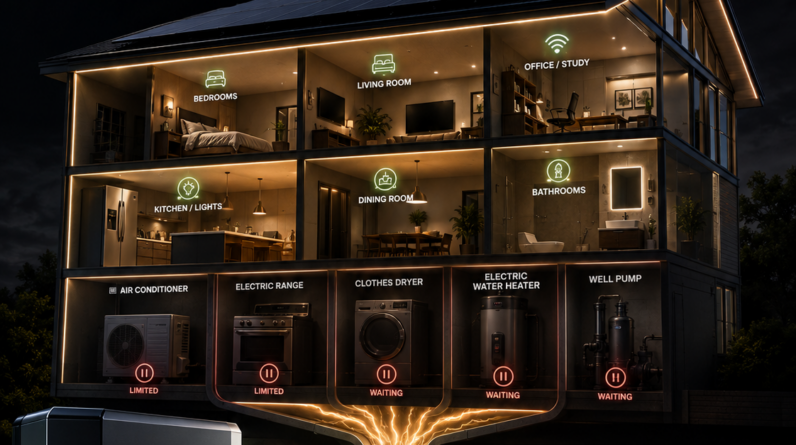
A battery system can be connected in a way that allows every circuit in the home to receive backup power without being able to run every major appliance at the same time.
Those are two different things.
One is about circuit coverage.
The other is about simultaneous load.
If you confuse them, you can buy a system that technically backs up your entire home but behaves very differently from what you imagined during an outage.
That distinction changes how you should evaluate battery backup.
Instead of asking only:
“Does this system back up my whole house?”
Ask:
“What can this system run at the same time?”
That second question gets much closer to what living through an outage will actually feel like.
Coverage tells you where power can go. Capacity and output determine what can actually happen once it gets there.
A system might supply backup power to your kitchen, bedrooms, HVAC equipment, laundry room, well pump, garage, and other circuits.
That doesn’t mean you can turn on the air conditioner, electric oven, clothes dryer, water heater, and well pump simultaneously and expect everything to operate normally.
The electrical panel may say yes.
The battery system may say no.
Think in Loads, Not Rooms
Homeowners naturally think about backup power by location.
- “I want the kitchen backed up.”
- “I need the bedrooms.”
- “I want the whole first floor.”
- “I want the entire house.”
But a battery doesn’t care which room an appliance sits in.
It sees electrical demand.
That means two appliances in different parts of the home can create a problem when they run at the same time, while ten smaller devices spread across the home might create no problem at all.
This is why circuit count can be misleading.
Imagine two homes with twenty backed-up circuits.
Home A
Home A has:
- A refrigerator
- Lights
- Internet equipment
- Televisions
- Gas heating controls
- Ceiling fans
- Typical outlets
Home B
Home B has those same circuits plus:
- Electric resistance heating
- A large air conditioner
- Electric water heating
- An electric range
- A clothes dryer
- A well pump
Both homes may be described as having whole-house backup.
Their backup experience could be completely different.
The difference isn’t the number of circuits.
It’s the collection of loads that may operate together.
A better sizing question is:
What combination of equipment creates my realistic peak demand during an outage?
That’s far more useful than simply adding up everything connected to the panel.
The Problem Is What Happens at the Same Time
You probably won’t run every appliance at once.
But you also shouldn’t assume you’ll carefully operate your home like a laboratory every time the power fails.
People forget.
A family member starts the dryer.
Someone preheats the oven.
The water heater is already running.
The air conditioner starts.
The well pump kicks on.
Each decision seems harmless by itself.
The problem is the overlap.
Battery backup sizing has to account for that overlap.
This creates what you can think of as a simultaneous-load problem.
The mistake is assuming that because several appliances are individually compatible with the system, they’re automatically compatible when operating together.
They may not be.
A system that can run Appliance A may run Appliance B.
It may run Appliance C.
That doesn’t automatically mean it can run A, B, and C simultaneously.
That simple distinction is one of the most useful things a homeowner can understand before buying a battery system.
Build a Priority Stack Before You Size the System
Instead of dividing your house into “backed up” and “not backed up,” divide your electrical loads into three groups.
Must-Run Loads
These are the things you want available throughout most outages.
Depending on the home, that might include:
- Refrigerators
- Freezers
- Essential lighting
- Internet equipment
- Medical equipment
- A well pump
- A sump pump
- Security equipment
- Heating controls
- Selected outlets
Nice-to-Run Loads
These improve comfort and convenience but don’t necessarily need unrestricted operation.
Examples might include:
- Air conditioning
- A microwave
- Dishwasher
- Television
- Garage door opener
- Selected kitchen equipment
- Home office equipment
Temporarily-Off Loads
These are devices you can intentionally avoid using while the grid is down, especially when other large loads are operating.
Depending on your home, that might include:
- Clothes dryer
- Electric range
- Pool equipment
- EV charging
- Electric water heating
- Other heavy electrical loads
The exact categories will vary.
That’s the point.
Backup sizing shouldn’t begin with what another homeowner considers essential. It should begin with what your household expects to do during an outage.
What Does “Whole House” Mean to You?
Consider a hypothetical home with:
- Refrigerator
- Freezer
- Lights
- Wi-Fi
- Several outlets
- Central air conditioning
- Electric range
- Clothes dryer
- Electric water heater
- Well pump
The homeowner says:
“I want whole-house backup.”
That phrase doesn’t tell us enough.
Suppose what they really mean is:
“We want the refrigerator and freezer running continuously. We need the well pump. We want lights and internet. We’d like to use the air conditioner when necessary. We can avoid the dryer during an outage, use the microwave instead of the electric range, and delay other heavy electrical loads.”
That’s a completely different design problem.
Now there’s a priority structure.
The battery system doesn’t necessarily need to reproduce normal grid behavior without restrictions. It needs to support the homeowner’s chosen outage behavior.
That difference can change the required system considerably.
Now change the homeowner’s expectation.
Suppose they say:
“No. If the grid goes down, I want everyone in the house to behave normally. I don’t want to think about which appliances are running. I want to cook dinner, run the air conditioner, use hot water, do laundry, pump water, and charge the car without managing anything.”
That’s also a legitimate preference.
But it’s a very different requirement.
Both people might use the phrase “whole house.”
One means:
“I want power available throughout my home, with some sensible load management.”
The other means:
“I want my battery system to imitate the utility grid as closely as practical.”
Those shouldn’t be treated as the same request.
That’s why the phrase “whole house backup” should start a conversation rather than end one.
Ask This Before You Buy
The fastest way to expose the difference is to ask:
What would you be annoyed to discover you couldn’t run at the same time?
That question is surprisingly powerful.
A homeowner might be perfectly comfortable avoiding the dryer.
They might not care about EV charging during an outage.
But discovering that they can’t operate their air conditioner while the well pump and another major load are running might matter a lot.
That’s the type of expectation you want to uncover before installation, not during the first outage.
Battery Capacity and Battery Output Are Different
There’s another layer to this.
The issue isn’t only how much energy your batteries store.
Homeowners often focus heavily on kilowatt-hours because battery capacity is easy to understand as stored energy.
More capacity generally means more energy available over time.
But the system also has limits on how much power it can deliver at a given moment.
Think of stored energy as how much electrical fuel you have available.
Think of output as how quickly the system can deliver that fuel.
You need both.
A large amount of stored energy doesn’t automatically mean unlimited appliance combinations.
That’s why you should evaluate backup systems using two separate questions:
1. How long can the system support my priority loads?
This is an endurance question.
2. Which of those loads can operate together?
This is a concurrency question.
They solve different problems.
Test Your Real-World Outage Scenario
Here’s a practical test you can use before discussing system size.
Picture the first evening of a summer outage.
The refrigerator and freezer are running.
Several lights are on.
Your internet equipment is operating.
The air conditioner starts.
Someone uses the microwave.
The well pump kicks on because someone turns on a faucet.
Maybe the electric water heater is operating too.
Now ask:
Is this a realistic combination in my house?
If the answer is yes, that combination matters more than an abstract list of every circuit connected to the backup system.
Run the same exercise for:
- Winter
- Breakfast
- Dinner
- The middle of the night
You’re not trying to invent the absolute worst electrical event your home could theoretically produce.
You’re identifying believable combinations that could happen without anyone doing anything unusual.
That’s the load profile worth designing around.
The Three-Question Backup Test
Before choosing a backup system, answer these three questions:
- What must stay available?
- What would I like to use when conditions allow?
- What am I willing to postpone or manage during an outage?
Once you can answer those three questions, “whole house” becomes much less mysterious.
You’ve moved from a marketing label to an operating plan.
And that operating plan tells you something valuable before you spend money.
Sometimes the right answer is:
- A larger battery system
- More inverter output
- Load management
- Moving certain equipment outside the backup plan
- Accepting that a few high-demand activities will wait until grid power returns
The right answer depends on your expectations.
The goal shouldn’t be to buy the system that backs up the most circuits.
The goal should be to buy the system whose limits match the way you actually intend to live during an outage.
The Rule to Follow
Don’t size backup by asking how much of the house is connected. Size it by asking what the household expects to run together.
Before buying anything labeled “whole house backup,” write down your:
- Must-run loads
- Nice-to-run loads
- Temporarily-off loads
Then identify the combinations you realistically expect to operate simultaneously.
If nobody can clearly tell you how the proposed system handles those combinations, you don’t yet know whether you’re buying whole-house backup or simply whole-house access to a limited amount of backup power.
That distinction may matter far more than the label on the proposal.
This post contains Amazon affiliate links.