This post contains Amazon affiliate links.
Can You Charge a Solar Power Bank Through a Window?
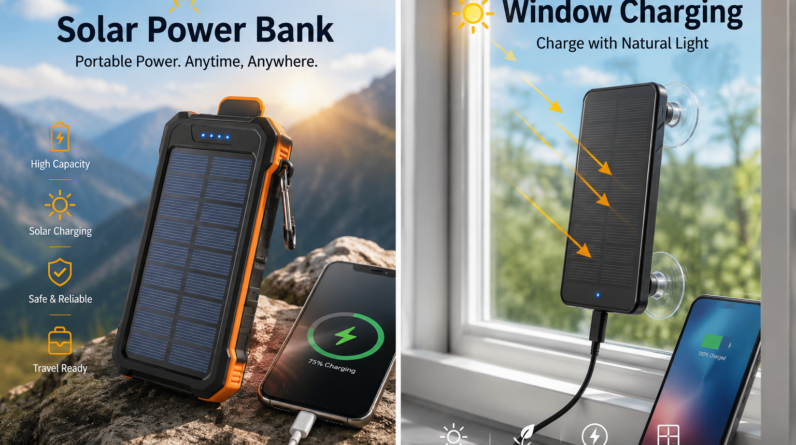
If you own a solar power bank, you might wonder whether you can simply place it on a sunny windowsill and let it charge.
The short answer is yes, a solar power bank can charge through a window, but it will usually charge much more slowly than it would outside in direct sunlight.
Glass reduces the amount of solar energy that reaches the panel. The angle of the sunlight, type of window, weather, and size of the solar panel can also make a big difference.
Here is what you should know before relying on a windowsill to keep your solar power bank charged.
Can Solar Panels Work Through Glass?
Solar panels can still produce electricity when sunlight passes through glass.
However, they do not receive as much usable sunlight as they would outdoors.
Most household windows block or reflect part of the sunlight before it reaches the solar panel. Modern energy-efficient windows may reduce solar energy even more because they are designed to limit heat and ultraviolet radiation entering the home.
That means your solar power bank may show that it is charging while sitting near a window, but the amount of electricity being generated could be very small.
Why Does a Solar Power Bank Charge Slower Through a Window?
Several things reduce charging performance indoors.
Glass Blocks Some Solar Energy
Window glass does not allow all sunlight to pass through.
Some sunlight is reflected away, while other parts of the solar spectrum may be filtered by the glass.
Tinted windows, double-pane windows, and low-emissivity windows can reduce the amount of solar energy reaching the panel even further.
The Solar Panel May Be at the Wrong Angle
Solar panels generally work best when sunlight hits them directly.
A solar power bank sitting flat on a windowsill may not be positioned at the best angle.
Changing the angle of the power bank so the solar panel faces the sun more directly can sometimes improve charging performance.
Indoor Temperatures Can Become High
A sunny windowsill can become surprisingly hot.
Solar panels often become less efficient as temperatures rise. Batteries also do not like extreme heat.
Leaving a power bank in a very hot window for long periods could potentially shorten the life of the battery.
The Solar Panel Is Usually Small
Most solar power banks have very small built-in solar panels.
These panels are mainly designed to provide supplemental charging rather than quickly recharge the entire battery.
Even outdoors, charging a large power bank from its built-in panel can take a long time.
Moving the power bank behind a window makes the process even slower.
How Long Does It Take to Charge a Solar Power Bank Through a Window?
There is no single charging time because solar power banks vary considerably.
A small solar power bank might take several days of strong outdoor sunlight to fully charge using only its built-in solar panel.
Behind a window, it could take considerably longer.
In weak sunlight, the power bank may gain very little usable battery power during an entire day.
This is one reason manufacturers commonly recommend charging solar power banks through USB before a trip or emergency.
The solar panel can then be used to add additional power when electricity is unavailable.
Is Direct Sunlight Better?
Yes.
Putting the solar power bank outside in direct sunlight will almost always work better than placing it behind a window.
For better solar charging:
- Place the panel in direct sunlight.
- Point the solar panel toward the sun.
- Avoid shade from trees, buildings, or other objects.
- Reposition the panel as the sun moves.
- Keep the solar panel clean.
- Avoid leaving the battery in extreme heat.
Even a small amount of shade across a solar panel can reduce its output.
What About Car Windows?
A solar power bank can also charge through a car window, but the same limitations apply.
Car windows may block even more solar energy than regular household glass, especially if the windows are tinted.
There is also another problem.
Cars can become extremely hot in direct sunlight.
Leaving a lithium battery power bank on a dashboard or seat in a hot vehicle is generally not a good idea.
High temperatures can damage batteries and may create a safety risk.
If you want to use solar charging while traveling, placing the solar panel outside the vehicle is usually a better option.
Will a Solar Charger Work on a Cloudy Day Through a Window?
Possibly, but charging will probably be very slow.
Solar panels can still generate electricity on cloudy days because some sunlight reaches the Earth’s surface.
However, cloud cover reduces the amount of available solar energy.
Add a window between the sun and the solar panel, and the available charging power drops even further.
You might see a charging indicator light, but that does not necessarily mean the power bank is receiving enough energy to charge quickly.
Can You Charge a Solar Power Bank With Indoor Lights?
Technically, some solar panels can produce a tiny amount of electricity from artificial light.
In practical terms, normal household lighting is usually far too weak to charge a solar power bank effectively.
A ceiling light or desk lamp produces much less usable energy than sunlight.
If you need to recharge your power bank indoors, USB charging is usually the better option.
What Is the Best Way to Charge a Solar Power Bank?
For everyday use, the fastest method is usually USB charging from a wall outlet.
Before a storm, camping trip, hurricane, or possible power outage, fully charge the power bank using electricity.
Then use the solar panel as a backup charging method if electricity becomes unavailable.
A good routine is:
- Fully charge the power bank using USB.
- Keep it stored somewhere cool and dry.
- Check the battery every few months.
- Recharge it if the battery level has dropped.
- Use solar charging during extended outages or outdoor trips.
This gives you a fully charged battery at the beginning of an emergency rather than starting with an empty battery and waiting for sunlight.
Built-In Solar Panel vs Folding Solar Panel
There is a major difference between the small solar panel built into a typical power bank and a larger portable solar panel.
Built-In Solar Power Bank Panel
A built-in panel is convenient because everything is contained in one device.
However, the panel is usually small.
It may work well for adding a little extra battery power over time, but it may not generate enough electricity for frequent phone charging.
Folding Solar Panel
A folding solar panel has much more surface area.
Larger portable panels can generate considerably more electricity and may charge phones, power banks, and portable power stations much faster.
For emergency preparedness, a separate folding solar panel paired with a power bank can be more practical than relying entirely on the tiny solar panel built into the power bank.
Should You Put a Solar Power Bank on Your Windowsill?
You can.
If the window receives several hours of direct sunlight, the power bank may slowly gain battery power.
Just keep expectations realistic.
A windowsill solar power bank is unlikely to charge as quickly as one sitting outdoors.
It can still be useful for maintaining some battery power or adding a small amount of charge throughout the day.
For situations where you need reliable emergency power, outdoor solar charging will usually produce much better results.
How to Get More Power From Your Solar Power Bank
If you have no other charging option, a few simple changes may help.
Place the power bank near the sunniest window in your home.
South-facing windows often receive the most sunlight in the Northern Hemisphere.
Adjust the angle of the panel so sunlight strikes it more directly.
Remove screens if possible because window screens can block additional sunlight.
Keep the panel clean.
Move the power bank outdoors when weather conditions allow.
Most importantly, do not depend on a small solar panel as your only emergency charging method.
Having multiple ways to charge your phone gives you much better protection during an extended outage.
Can a Solar Power Bank Keep Your Phone Charged During an Emergency?
It can help.
A fully charged power bank may recharge a smartphone several times depending on the battery capacity of both devices.
The built-in solar panel can then slowly replace some of the electricity you use.
If the outage lasts several days, a larger portable solar panel can provide much more useful charging capacity.
For emergency situations, you might consider having:
- A fully charged power bank
- A solar charging option
- USB charging cables
- A car charger
- A second backup battery
- A larger portable solar panel for extended outages
Having several charging options reduces the chance that you will lose phone access during an emergency.
Frequently Asked Questions
Can a solar power bank charge inside a house?
Yes. If enough sunlight reaches the solar panel through a window, it may charge. Charging will usually be slower than outdoors.
Does window glass stop solar panels from working?
No. Solar panels can still generate electricity through glass, but glass reduces the amount of solar energy reaching the panel.
Can I leave my solar power bank in the window all day?
You can place it near a sunny window, but watch the temperature. If the device becomes extremely hot, move it somewhere cooler.
Will a solar power bank charge through tinted glass?
It may, but tinted glass can reduce the amount of sunlight reaching the solar panel and make charging even slower.
Can I charge a solar power bank through a car windshield?
It may charge, but vehicle interiors can become dangerously hot. Outdoor charging is usually safer and more effective.
Is solar charging enough for emergencies?
Solar charging can be useful during extended outages, but it is better to start with a fully charged power bank and use solar power as an additional charging source.
The Bottom Line
You can charge a solar power bank through a window, but you probably will not get the same performance you would from direct outdoor sunlight.
For occasional charging, a sunny windowsill may provide some extra battery power.
For camping, hurricanes, blackouts, or other emergency situations, placing the solar panel outdoors will usually provide much faster charging.
And if you want dependable emergency phone power, start with a fully charged power bank before the electricity goes out.
This post contains Amazon affiliate links.