This post contains Amazon affiliate links.
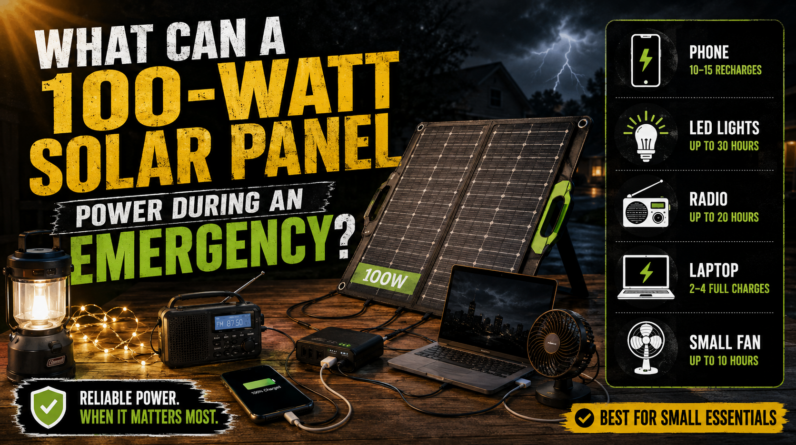
100-Watt Solar Panel Power During an Emergency?
A 100-watt solar panel can be surprisingly useful during a power outage.
It will not run your entire house, and you should not expect it to power an air conditioner or electric heater. But paired with a battery or portable power station, a 100W panel can help keep phones, lights, radios, laptops, fans, internet equipment, and other small devices running.
For many people, that is exactly what matters most during an emergency.
A 100-watt solar panel can typically produce several hundred watt-hours of electricity during a good sunny day, although actual production depends heavily on weather, season, location, panel angle, temperature, and shading.
Here is what that means for the devices you may want to use during a blackout.
How Much Power Does a 100-Watt Solar Panel Actually Produce?
A 100-watt solar panel is rated to produce up to 100 watts under favorable test conditions.
That does not mean it produces 100 watts continuously from sunrise until sunset.
Solar output changes throughout the day.
Your panel may produce close to its rated output around the strongest part of a sunny day, while producing much less during the morning, evening, cloudy weather, or poor positioning.
If you receive about five useful peak-sun hours, a simple theoretical calculation would be:
100 watts × 5 hours = 500 watt-hours
Real-world production is usually lower because of efficiency losses and changing conditions.
For emergency planning, it is better to treat the panel’s rated output as a maximum rather than guaranteed production.
What Can You Power With 100 Watts of Solar?
A 100W solar panel works best with smaller electronics and low-power emergency equipment.
Possible uses include:
- Smartphones
- Power banks
- Tablets
- Laptops
- LED lights
- Rechargeable flashlights
- Emergency radios
- Wi-Fi routers
- Small fans
- Cameras
- GPS devices
- Rechargeable batteries
- Some CPAP setups
- Small portable power stations
The amount of time you can run these devices depends on how much electricity the panel generates and how much energy you can store.
If your main concern is keeping several USB devices operating during an outage, see our guide to emergency solar chargers that can charge multiple devices.
A Solar Panel Does Not Store Electricity
This is one of the most important things to understand.
A solar panel produces electricity.
It does not store it.
If you want reliable emergency power, you will normally connect your 100W panel to something that can store the electricity.
That might be:
- A portable power station
- A solar generator
- A compatible battery system
- A power bank designed for external solar input
The battery stores electricity while the sun is shining.
You can then use that electricity at night, during cloudy periods, or whenever you need it.
If you are trying to decide whether you need a battery power station at all, read Is a Solar Generator Necessary for Short Outages?.
Can a 100W Solar Panel Charge a Phone?
Yes.
Charging smartphones is one of the easiest jobs for a 100W solar panel.
A phone battery stores a relatively small amount of energy compared with a large portable power station.
A 100W panel could potentially provide enough daily energy for numerous phone charges under good conditions.
The more practical approach is usually to connect the solar panel to a power station or compatible power bank and charge your phone from that battery.
This gives you more consistent charging even when clouds pass overhead.
For a multi-day outage strategy, see our guide on how to keep your phone charged during a 3-day power outage.
Can a 100W Solar Panel Charge a Power Bank?
Yes, provided the power bank supports charging from an external solar panel and the voltage and connectors are compatible.
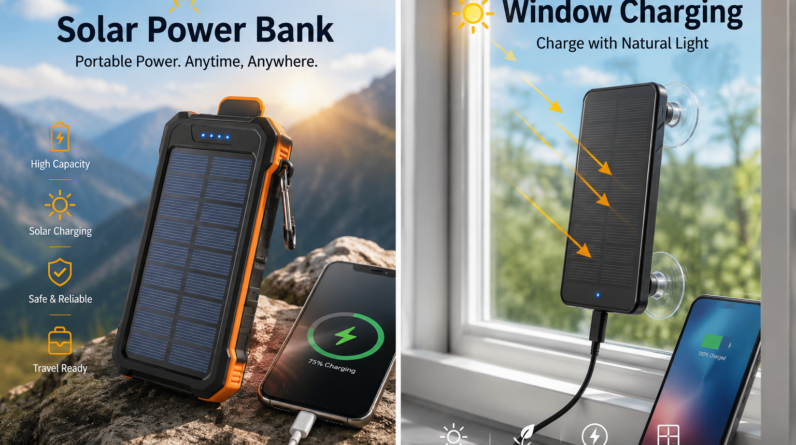
This is different from a solar power bank that has a tiny panel built directly into its case.
A full-size 100W panel has far more solar surface area.
That means it can generate considerably more electricity under good conditions.
If your power bank accepts only USB input, you may need a solar panel with a compatible USB output or an appropriate charging controller.
Never connect equipment together unless the voltage and charging specifications are compatible.
Can a 100W Solar Panel Run LED Lights?
Absolutely.
LED lighting requires relatively little electricity.
Suppose you have four 10-watt LED bulbs.
Running all four at once would require:
4 × 10 watts = 40 watts
If you ran them for five hours, they would consume:
40 watts × 5 hours = 200Wh
A 100W solar panel could potentially collect enough energy during a sunny day to provide several hours of LED lighting later that evening.
During an emergency, you can reduce electricity use further by lighting only the rooms you are actually using.
Can a 100W Solar Panel Run a Wi-Fi Router?
In many cases, yes.
Home internet equipment often uses far less than 100 watts.
A modem and router might consume roughly 10 to 30 watts combined, although equipment varies.
If your setup uses 20 watts and operates for eight hours:
20 × 8 = 160Wh
That is a reasonable load for a small solar-and-battery setup.
There is an important catch.
Keeping your router powered does not guarantee that your internet service will remain available.
A widespread outage may also affect your internet provider’s local equipment.
Still, powering your router can be worthwhile because internet service may continue working even when household electricity is out.
Can a 100W Solar Panel Run a Laptop?
A 100W solar panel can help keep many laptops charged.
Laptop power consumption varies considerably.
A lightweight laptop used for basic work might use relatively little electricity, while a gaming laptop can use considerably more.
Rather than connecting the laptop directly to the panel, charging a portable power station during the day and using the power station for your laptop usually provides more consistent power.
For someone who works from home, this setup could provide enough electricity for a few hours of essential work during an outage.
Can a 100W Solar Panel Run a Fan?
Small fans can be a good emergency load for a 100W solar setup.
A small USB or efficient portable fan may consume very little electricity.
Larger household fans require more.
For example, a 30-watt fan running for five hours would consume:
30 × 5 = 150Wh
That can be a reasonable amount of energy for a 100W panel to replace during a sunny day.
During a summer blackout, using a fan rather than trying to run an air conditioner can dramatically reduce your power requirements.
Can a 100W Solar Panel Run an Emergency Radio?
Yes.
Emergency radios usually require very little electricity compared with household appliances.
A 100W panel paired with a battery can easily provide enough energy to recharge many radios while still leaving electricity available for phones and lights.
Keeping a separate radio also reduces how often you need to use your phone for weather and emergency updates.
Can a 100W Solar Panel Run a CPAP Machine?
Possibly, but you need to check your specific CPAP machine.
CPAP energy consumption varies.
Using a heated humidifier or heated tubing can substantially increase how much electricity the machine requires.
A 100W solar panel may be able to replace much or all of the energy used by an efficient CPAP during the day, particularly if heating features are disabled.
However, the solar panel cannot power the CPAP at night unless you have a battery storing the energy.
If a CPAP or another medical device is medically necessary, build additional battery capacity and charging options into your emergency plan rather than relying on the minimum possible setup.
Can a 100W Solar Panel Run a Refrigerator?
This is where things get more complicated.
A refrigerator may draw somewhere around 100 to several hundred watts while the compressor is running, with a higher startup surge.
The refrigerator cycles on and off throughout the day.
A 100W solar panel by itself generally does not provide enough reliable output to operate a refrigerator directly.
It can, however, contribute electricity to a portable power station that powers the refrigerator.
The issue is daily energy production.
A refrigerator may consume much more electricity over 24 hours than a single 100W panel can replace.
If keeping food cold is one of your main emergency priorities, see our guide to solar generators for emergency food preservation and refrigerator power.
For refrigerator backup, you will often want more solar capacity than a single 100W panel.
Can a 100W Solar Panel Run a Freezer?
The answer is similar to a refrigerator.
A freezer needs a battery system with enough inverter output to handle the compressor.
A 100W panel can contribute to recharging that battery, but it may not generate enough daily electricity to replace everything the freezer consumes.
An efficient chest freezer that stays closed may use relatively little electricity, but you should check its actual consumption before depending on one 100W panel.
Can a 100W Solar Panel Power a TV?
Possibly.
Some modern televisions may consume less than 100 watts, while larger models may use more.
But even if a TV draws only 70 watts, running it for four hours would consume:
70 × 4 = 280Wh
During a blackout, that is a meaningful amount of your available solar energy.
You may decide that phones, lights, refrigeration, radios, and internet access deserve priority over television.
Can a 100W Solar Panel Run a Microwave?
Not directly in a practical emergency setup.
Microwaves commonly require around 1,000 watts or more while operating.
That is far beyond the output of a 100W panel.
A sufficiently large portable power station could operate a microwave while the 100W solar panel slowly replenishes some of the electricity afterward.
The panel itself is not what allows the microwave to run.
The battery and inverter do the heavy work.
Can a 100W Solar Panel Run a Coffee Maker?
A typical electric coffee maker may require hundreds or more than 1,000 watts while heating water.
That means a 100W panel cannot directly provide enough power.
A larger solar generator could run a coffee maker briefly, with the 100W panel contributing to recharging the battery afterward.
If battery capacity is limited, heating water electrically may not be the best use of emergency power.
Can a 100W Solar Panel Run a Space Heater?
No, not realistically.
Many portable electric space heaters use around 1,500 watts.
A 100W solar panel produces only a small fraction of that.
Even with a battery, a space heater can drain stored electricity extremely quickly.
Electric resistance heating is one of the hardest loads to support with a small emergency solar setup.
Can a 100W Solar Panel Run an Air Conditioner?
A typical household air conditioner requires far more electricity than a single 100W solar panel can provide.
Even small window or portable air conditioners can draw hundreds of watts.
Larger air-conditioning systems can require thousands.
A 100W panel is much better suited to powering an efficient fan.
If air conditioning is a major part of your emergency plan, you need a much larger solar array and battery system.
What About a Mini Fridge?
A mini refrigerator may be a more realistic load than a full-size kitchen refrigerator.
However, you still need to check:
- Running watts
- Startup surge
- Daily energy consumption
Some efficient mini refrigerators can work reasonably well with small portable power stations.
A 100W panel could then help recharge the battery during daylight.
Whether it can replace all the electricity used each day depends on the appliance.
How Long Does It Take a 100W Solar Panel to Charge a Power Station?
The answer depends on the battery size.
Suppose you have a 500Wh portable power station.
In perfect conditions, a 100W input would theoretically require about:
500Wh ÷ 100W = 5 hours
Real charging takes longer because the panel does not produce its maximum output continuously and some energy is lost during charging.
A 500Wh battery might therefore require most of a good sunny day to recharge from a single 100W panel.
A 1,000Wh battery could take considerably longer.
That is why people with larger power stations often use 200W, 400W, or larger solar arrays.
100W Solar Panel With a 300Wh Power Station
This can make a useful compact emergency setup.
It is well suited to:
- Phones
- Lights
- Tablets
- Radios
- Small fans
- Some laptop charging
The 100W panel is reasonably matched to the smaller battery size and may be able to restore a meaningful percentage of its capacity during a sunny day.
100W Solar Panel With a 500Wh Power Station
This is another practical combination.
A 500Wh battery provides more reserve energy while the 100W panel gives you a way to replenish it.
You could use this system for phones, lights, internet equipment, laptops, radios, and selected low-power devices.
If you only experience short blackouts, though, you may not need a solar generator at all. Our article on whether a solar generator is necessary for short outages can help you decide.
100W Solar Panel With a 1,000Wh Power Station
A 100W panel can charge a 1,000Wh battery, but it may be slow.
If you heavily use the battery each day, a single 100W panel may struggle to replace all of the electricity you consume.
For a 1,000Wh or larger power station, moving up to 200W or more of solar input can make the system much more useful during a multi-day outage.
How Much Can a 100W Panel Produce in One Day?
The answer varies dramatically by location and conditions.
For a rough example, if your panel averages the equivalent of four to five hours at strong output, you might theoretically see around 400 to 500Wh before accounting for losses.
You could get more under excellent conditions or considerably less under poor conditions.
Factors include:
- Season
- Latitude
- Clouds
- Temperature
- Panel orientation
- Shade
- Dirt
- Charging efficiency
- Length of daylight
Do not build an emergency plan around the assumption that you will get the panel’s maximum possible production every day.
What Can 400Wh of Electricity Actually Do?
Suppose your 100W panel collects roughly 400Wh of usable energy during the day.
You could potentially divide that electricity among several small loads.
For example:
- Several smartphone charges
- Several hours of LED lighting
- A few hours of laptop use
- Several hours of Wi-Fi
- A small fan
- Radio charging
You probably could not do all of those things heavily at the same time.
Emergency solar works best when you decide which devices have priority.
Prioritize Your Emergency Loads
During a blackout, rank your devices.
Priority 1: Communication
Keep phones and emergency communication equipment working.
Priority 2: Medical Equipment
Necessary medical equipment should receive power before convenience devices.
Priority 3: Lighting
LED lights use little electricity and provide a major safety benefit.
Priority 4: Information
Radios and internet equipment can keep you informed.
Priority 5: Comfort and Work
Fans, laptops, tablets, and entertainment come after essential needs.
That approach can make a relatively small solar setup last much longer.
Will a 100W Solar Panel Work on Cloudy Days?
Yes, but output will be lower.
Solar panels can still generate electricity under cloud cover.
How much depends on how thick the clouds are and other conditions.
A panel that produces close to 100 watts in strong direct sunlight might produce far less during heavy cloud cover.
This matters during emergencies because severe weather often causes power outages.
The same storm that knocks out the grid may also reduce your solar production.
That is why starting an outage with a fully charged battery is so valuable.
For more on the tradeoffs, see the pros and cons of solar chargers compared with other backup power options.
Does Shade Affect a 100W Solar Panel?
Yes.
Shade can significantly reduce output.
Do not assume that putting the panel outdoors is enough.
Look for shadows from:
- Trees
- Chimneys
- Buildings
- Fences
- Vehicles
- Utility poles
Even if the panel starts the morning in full sun, the location may become shaded later as the sun moves.
Check its position during the day.
Does the Angle of the Panel Matter?
Yes.
A solar panel generally produces more electricity when sunlight strikes it at a favorable angle.
A portable panel laying flat on the ground may not collect as much energy as one tilted toward the sun.
Many folding solar panels include kickstands that make positioning easier.
You may improve daily production by adjusting the panel once or twice as the sun moves.
Is 100 Watts Enough for Emergency Solar Power?
For small electronics, it can be.
A 100W panel is a good entry point for someone whose emergency priorities are:
- Phones
- Lights
- Radio
- Laptop
- Internet
- Power banks
- Small fans
If you are trying to run refrigerators, freezers, cooking appliances, or other larger loads, 100 watts of solar may feel restrictive.
That does not necessarily mean you need a completely different system.
Many portable power stations allow you to connect additional panels later.
You could begin with 100W and eventually move to 200W or 400W of solar capacity.
100W vs 200W Solar Panel for Emergency Use
A 200W panel can theoretically produce twice as much power as a 100W panel under the same conditions.
That can make a major difference during a long outage.
More solar capacity means you may be able to:
- Recharge your battery faster
- Recover more energy on partly cloudy days
- Support larger batteries
- Run more devices
- Replace more of your daily electricity use
The tradeoff is size, weight, storage space, and cost.
For phone charging and a few small devices, 100W may be plenty.
For refrigerator backup and multi-day outages, 200W or more becomes much more attractive.
Is a 100W Solar Panel Better Than a Small Solar Power Bank?
They serve different purposes.
A solar power bank is compact and easy to carry.
A 100W folding panel is much larger but generates far more electricity.
For a go bag or hiking trip, a compact charger may be more convenient. See our guide to small solar chargers that fit in emergency go bags.
For a home power outage, a 100W panel connected to a decent battery will usually provide much more useful solar charging capacity.
Frequently Asked Questions
What can a 100-watt solar panel run?
A 100W solar panel can help power or recharge phones, tablets, laptops, LED lights, radios, routers, power banks, small fans, and other low-power electronics when paired with compatible charging equipment or a battery.
Can a 100W solar panel power a refrigerator?
A 100W panel generally cannot reliably operate a full-size refrigerator by itself. It can contribute energy to a battery or solar generator that powers the refrigerator, but you may need more solar capacity to replace the refrigerator’s daily electricity use.
Can a 100W solar panel charge a portable power station?
Yes, if the power station supports the panel’s voltage, current, connector, and input specifications.
How long will a 100W solar panel take to charge a 500Wh battery?
The theoretical minimum at a constant 100W would be five hours, but actual charging typically takes longer because solar output varies and charging losses occur.
Can a 100W solar panel charge a phone?
Yes. Phone charging requires relatively little electricity, making smartphones a good match for a 100W emergency solar setup.
Can I run a 100W solar panel directly into my phone?
Only if the panel has a compatible regulated USB or USB-C charging output designed for that purpose. In many setups, it is better to charge a battery or portable power station first.
Is a 100W solar panel enough for camping?
For many campers, yes. A 100W panel can provide useful charging for phones, cameras, lights, power banks, laptops, and other small electronics.
Will a 100W solar panel work during a blackout?
Yes. Solar panels do not need the electrical grid to generate power. You will need compatible equipment to safely use or store the electricity they generate.
Is a 100-Watt Solar Panel Worth Having for a Power Outage?
For basic emergency power, a 100W solar panel can be one of the more practical sizes to own.
It is small enough to remain portable but large enough to produce meaningful electricity.
Pair it with a battery or portable power station and you can use sunlight to keep essential electronics operating even when household electricity has been unavailable for several days.
Just keep its limitations in mind.
A 100W panel is excellent for phones, lights, radios, routers, laptops, power banks, and smaller devices.
It is not a substitute for a large home backup system.
If you want to run refrigerators, freezers, cooking appliances, air conditioners, or other power-hungry equipment, you will probably want more solar capacity and a larger battery.
For basic emergency preparedness, though, a 100W panel paired with a properly sized battery can provide a very useful source of electricity when the grid is down.
And if your main goal is simply keeping phones and other USB electronics working, check out our guide to emergency solar chargers that can charge multiple devices.
This post contains Amazon affiliate links.